
Introduction:
An Irish blessing gets used year-round — on a wedding program, a sympathy card, a baby’s christening gift, a St. Patrick’s Day card recycled every March. Most people can recite a line or two of “May the road rise to meet you” without ever being told what it actually means, or that its imagery — wind, sun, rain, a hand holding you — traces straight back to Scripture.
It reads like Celtic folk poetry, and in a sense it is, but the images inside it were never chosen at random. Ireland’s own Christian history, going back to St. Patrick’s mission in the 5th century, shaped this blessing long before it became a wedding-toast staple. Below is the traditional Irish blessing in full, what each line means biblically, where it likely came from, and where to use it — for a wedding, a birthday, a new baby, a journey, a new home, or a funeral.
What Is the Traditional Irish Blessing?
The most widely recited Irish blessing is a short prayer for safe passage through life, traditionally attributed to St. Patrick and passed down in Gaelic before being translated into English.
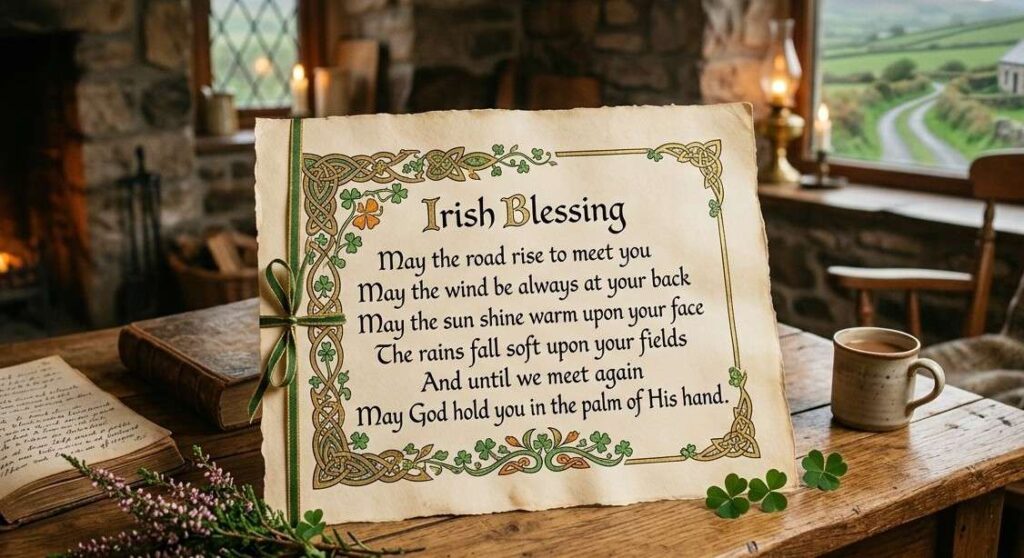
May the road rise to meet you, May the wind be always at your back, May the sun shine warm upon your face, And rains fall soft upon your fields, “And until we meet again, May God hold you in the palm of His hand.”
In the original Gaelic, “Go n-éirí an bóthar leat” translates more literally to “may the road succeed with you” — a wish for the journey itself to go well, not just the destination. St. Patrick, a 5th-century missionary credited with establishing Christianity across Ireland, is the reason so many Celtic blessings carry a Christian undertone even when they read like folk poetry.
Some of this Christian imagery is also attributed to St. Patrick directly through St. Patrick’s Breastplate, a much longer prayer traditionally credited to him that begins “I arise today, through a mighty strength, the invocation of the Trinity.” It’s less commonly quoted than “May the road rise,” but it’s the source many shorter Irish blessings are thought to echo — armor-like language asking for God’s strength “before me,” “behind me,” and “in the mouth of everyone who speaks of me.”
That heritage is why the blessing has outlasted a thousand secular St. Patrick’s Day cards: it was never meant as decoration. It was meant as a prayer.
What Does the Irish Blessing Actually Mean?
Every image in the blessing — wind, sun, rain, a hand — has a scriptural root, which is exactly what most “top 10 Irish blessings” lists skip over.
The wind represents God’s presence and provision, echoing how the Holy Spirit is described arriving at Pentecost.
“And when the day of Pentecost was fully come, they were all with one accord in one place. And suddenly there came a sound from heaven as of a rushing mighty wind, and it filled all the house where they were sitting.” — Acts 2:1-2 (KJV)
The sun stands for God’s mercy — a comparison Scripture makes directly when describing the coming of Christ.
“Through the tender mercy of our God; whereby the dayspring from on high hath visited us,” — Luke 1:78 (KJV)
“The palm of His hand” isn’t a direct Bible quotation, but it echoes a real promise — that nothing can remove you from God’s grip once He’s holding you.
“And I give unto them eternal life; and they shall never perish, neither shall any man pluck them out of my hand.” — John 10:28 (KJV)
“The eternal God is thy refuge, and underneath are the everlasting arms:” — Deuteronomy 33:27 (KJV)
Read this way, the blessing isn’t just pleasant-sounding folklore. It’s a compressed prayer built from real biblical promises — safety in the journey, mercy in the waiting, and a grip that doesn’t let go.
Short Irish Blessings for Everyday Use
Not every occasion needs the full traditional version. These shorter lines work well in a card, a text, or spoken quickly before someone heads out the door — including a quick Irish blessing for good luck before a big day.
- “May your pockets be heavy and your heart be light.”
- “May good luck pursue you each morning and night.”
- “May you have the hindsight to know where you’ve been, the foresight to know where you are going, and the insight to know when you have gone too far.”
- “May the road rise to meet you, and the wind be always at your back.”
These shorter blessings borrow the same themes — safety, provision, direction — condensed into a single line, which is part of why they’ve stayed so quotable for generations.
Irish Blessing for a Wedding
A wedding-specific Irish blessing tends to focus on the home the couple is about to build together, not just the ceremony itself.
“May you have walls for the wind, a roof for the rain, and tea by the fire.”
This line works because it doesn’t promise an easy life — it promises shelter through whatever the weather brings, which is a far more honest wish for a marriage than “happily ever after.” Numbers 6:24-26, the oldest recorded blessing in Scripture, pairs well here for a reading with more explicit faith language:
“The LORD bless thee, and keep thee: The LORD make his face shine upon thee, and be gracious unto thee: The LORD lift his countenance upon thee, and give thee peace.” — Numbers 6:24-26 (KJV)
Irish Blessing for a Birthday
An Irish birthday blessing leans into humor about time passing, rather than dwelling on age as something to dread.
“May you live as long as you want and never want as long as you live.”
It’s a clever double meaning — long life, and a life where nothing essential is lacking — which is why it’s held up better than most greeting-card verses written for the same occasion.
Irish Blessing for a Baby or New Child
An Irish blessing for a new baby usually asks for guardianship and gentleness rather than achievement — protection for a life that hasn’t started yet.
“May there be a generation of children on the children of your children.”
“May you have a world of wishes at your command. God and his angels close to hand.”
Both lean on the same “protecting hand” theme as the traditional version, just scaled down to a christening card or a baby-shower gift tag. Psalm 127:3 fits naturally alongside either one: “Lo, children are an heritage of the LORD: and the fruit of the womb is his reward.” (KJV)
Irish Travel Blessing
A slightly different version of the traditional blessing exists specifically for someone setting out on a journey, swapping the funeral-adjacent “until we meet again” for a more forward-looking wish.
“May the road rise up to meet you. May the wind always be at your back. May the sun shine warm upon your face, and rains fall soft upon your fields. May the hand of a friend always be near.”
Psalm 121:8 covers the same ground in plain scriptural language: “The LORD shall preserve thy going out and thy coming in from this time forth, and even for evermore.” (KJV) It’s a fitting line for a going-away card, a graduation, or anyone relocating for a new job.
Irish Blessing for the Home
A house blessing traditionally asks for protection and warmth to fill the physical space itself, not just the people living in it.
“May you always have walls for the winds, a roof for the rain, tea beside the fire, laughter to cheer you, those you love near you, and all your heart might desire.”
Praying this over a new home, room by room, is a practice with real roots — Deuteronomy 6:9 instructs God’s people to write His words on their doorframes, making a home’s protection something spoken and visible, not just assumed.
Irish Blessing for a Funeral or Memorial Service
An Irish blessing is one of the most commonly chosen readings at funerals, largely because its imagery of a journey and a hand that doesn’t let go translates naturally into comfort for the grieving.
“And until we meet again, may God hold you in the palm of His hand.”
That single line does two things at once: it acknowledges parting without pretending it isn’t painful, and it places the person somewhere safe in the meantime. Scripture offers the same comfort more directly for those planning a service.
“But I would not have you to be ignorant, brethren, concerning them which are asleep, that ye sorrow not, even as others which have no hope: For if we believe that Jesus died and rose again, even so them also which sleep in Jesus will God bring with him.” — 1 Thessalonians 4:13-14 (KJV)
“And God shall wipe away all tears from their eyes; and there shall be no more death, neither sorrow, nor crying, neither shall there be any more pain: for the former things are passed away.” — Revelation 21:4 (KJV)
Reading the traditional blessing alongside one of these verses gives a funeral program both the warmth of Irish tradition and the weight of an actual promise, rather than just a sentimental line.
The Funny Irish Blessing
Irish humor rarely stays sentimental for long, and blessings are no exception — many end with an unexpected turn that gets a laugh right after the heartfelt part.
“May those who love us love us. And those that don’t love us, may God turn their hearts. And if He doesn’t turn their hearts, may He turn their ankles, so we’ll know them by their limping!”
The humor works precisely because it follows the same “May…” structure as the serious blessings — the format sets up an expectation the punchline then breaks.
Frequently Asked Questions
What is the most famous Irish blessing?
“May the road rise to meet you” is the most recited version, most often ending with “May God hold you in the palm of His hand.” It’s used at weddings, funerals, and farewells alike.
Are Irish blessings religious?
Yes, at their root. Most trace back to Ireland’s Christian heritage following St. Patrick’s mission there in the 5th century, and their imagery — wind, sun, a protecting hand — echoes real Bible passages like Acts 2:1-2 and Deuteronomy 33:27, even in versions that read as folk poetry today.
What does “may the road rise to meet you” mean?
It’s a wish that your path through life goes smoothly, translated from the Gaelic “Go n-éirí an bóthar leat,” which more literally means “may the journey succeed with you.”
How do you say “cheers” in Irish Gaelic?
The common toast is “Sláinte” (pronounced slawn-cha), meaning “health.”
Is an Irish blessing appropriate for a funeral?
Yes — it’s one of the most commonly read pieces at Irish and Irish-American funerals specifically because of its themes of safe passage and being held until reunited again.
What’s a good Irish blessing for a friend moving away?
“May the road rise to meet you” fits well, or the shorter travel version ending in “May the hand of a friend always be near.”
Did St. Patrick write the Irish blessing?
No direct authorship of “May the road rise” has ever been confirmed. St. Patrick’s Breastplate, a longer and separate prayer, is more directly credited to him, and its “Christ before me, Christ behind me” structure is often cited as an influence on later, shorter Irish blessings.
Conclusion
An Irish blessing carries more weight than a greeting-card verse once you see where its imagery actually comes from. Wind, sun, rain, and a steady hand aren’t just pretty nature language — they’re a compressed version of promises Scripture makes directly.
Whichever occasion you’re reading one for — a wedding, a birthday, a new baby, a journey, or a funeral — the words hold up because they were never just decoration to begin with.


