

Introduction: A Complete Guide to Love, Marriage & Friendship
There are moments in life when a relationship brings you to your knees — not in reverence, but in confusion, grief, or desperate hope. A crumbling marriage. A friendship that suddenly feels hollow. A new romance full of promise and fear at the same time.
In those moments, many people find themselves turning to scripture, not as a last resort, but because something in the ancient words speaks to what is happening right now. Bible verses about relationships have endured for thousands of years precisely because they were forged in the same human fires we still face today.
This guide walks through the passages that matter most — for romantic love, marriage, friendship, conflict, and healing. More importantly, it shows you how to move from reading a verse to actually living it.
“The biblical vision for human connection is more demanding and more beautiful than we often expect. It doesn’t promise perfection — it promises something better: depth.”
Why Scripture Still Speaks to Modern Relationships
The Bible was not written from a place of comfort. Its authors wrote through war, exile, betrayal, and loss. That context matters because it means these words were never theoretical — they were tested under pressure. And they survived.
At the core of Christian teaching about relationships is a single claim: love originates with God, and every human bond is an opportunity to reflect that love into the world. Covenant commitment, sacrificial love, and honest forgiveness are not just theological vocabulary. They are the load-bearing walls of every relationship that lasts.
What does the research say? Marriage counselors and pastoral therapists consistently report that couples and individuals anchored in scriptural truth tend to recover from conflict more quickly and build deeper emotional trust over time. The principles work — not because they are magic, but because they redirect us away from self-centered relational patterns and toward something more durable.
Foundational Bible Verses About Love and Relationships
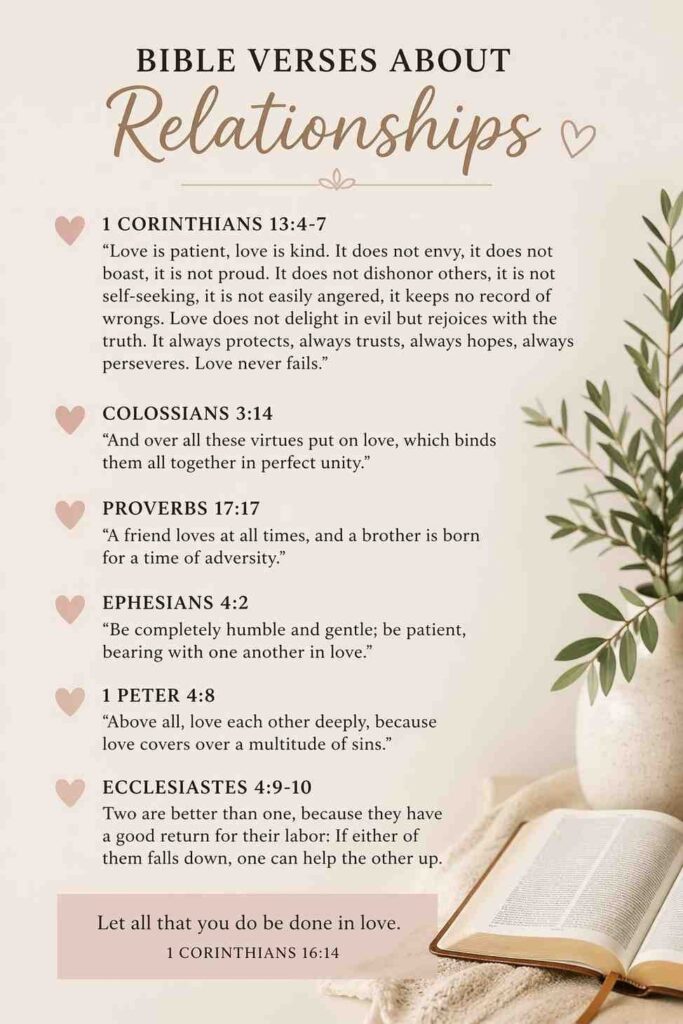
1. The Full Definition of Love — 1 Corinthians 13:4–7
This is perhaps the most cited passage in all of Christian writing on relationships — and still one of the most misunderstood. We hear it at weddings. We put it on cards. And then, a few weeks later, we go right back to being impatient, keeping score, and demanding our own way.
What this passage actually teaches is that love is not primarily a feeling. It is a sustained series of daily decisions. Choosing patience when frustration would be easier. Letting go of resentment rather than cataloguing every failure. Focusing on the other person’s good rather than your own comfort. For anyone in a long-term relationship — a marriage of thirty years, a friendship of a decade — that reframe is quietly revolutionary. You are not waiting to feel generous. You are choosing to be generous, even when the feeling is nowhere in sight.
Love as deliberate, ongoing action rather than spontaneous emotion — the foundation of all durable relational bonds.
2. The New Standard of Loving Others — John 13:34–35
In this passage, a new benchmark is introduced for how followers of Christ should love one another — not as we already love ourselves, but with full, voluntary self-giving. It is a standard that completely reorients the question we bring into every relationship. Instead of asking “what am I getting from this?” we begin to ask “what am I genuinely willing to give?” That shift in perspective, however slow it comes, has the power to transform how we treat a partner, a friend, a difficult family member, or even a stranger.
Bible Verses About Relationships and Romantic Love
Scripture does not use the language of modern dating, but its principles apply to it with striking precision. These short Bible verses about relationships speak directly to the questions people ask when they are navigating romantic discernment.
3. Shared Foundation Matters — 2 Corinthians 6:14
The agricultural image here is vivid: two animals mismatched in size will not pull a plow forward. They will pull against each other and go nowhere. Applied to romantic relationships, this principle is not about finding someone religiously identical to you in every practice and preference. It is about shared core values, shared direction, and genuine alignment on what matters most. When those foundations are present, a relationship has structural stability. When they are absent, even the most intense romantic chemistry tends to erode under the weight of real life.
4. Guard Your Heart With Intention — Proverbs 4:23
This verse carries both a warning and an explanation. The heart, in biblical wisdom literature, is the source from which everything else in a person’s life flows — decisions, desires, patterns of relating, and how we treat people when we are tired or scared. Guarding your heart is not permission to be emotionally unavailable or to keep every potential partner at arm’s length forever. It is an invitation to be intentional. Let trust develop at the pace trust actually requires. Pay attention to a person’s character over time, not just their best moments.
5. Do Not Rush Love Before Its Season — Song of Solomon 8:4
This phrase appears repeatedly in one of scripture’s most honest and human books. Its message is consistent: love has a season, and forcing it before that season arrives causes real harm. If you have ever felt external pressure to move a relationship faster than feels right — to commit before you are ready, to be physically intimate before genuine trust is established — this passage is quiet but clear permission to slow down. Divine timing is not a cliché. It is a principle that protects both people involved.
Bible Verses About Love and Relationships in Marriage
6. The Original Blueprint — Genesis 2:24
This verse describes what the covenant of marriage actually creates: a bond so primary that it reshapes the entire relational landscape of both people involved. The language of leaving and uniting is deliberate. Marriage does not simply add a new relationship to your existing life — it establishes a new primary bond that both partners are called to protect and prioritize. That does not mean cutting off family. It means that the marriage relationship takes precedence, and both people treat that bond accordingly.
7. Strength Built Together — Ecclesiastes 4:9–12
Anyone who has tried to carry a heavy burden alone already understands what this passage is saying: two people working together accomplish more, recover faster, and endure longer than either one could alone. But the most striking image here is the third strand in the cord. In a faith-centered marriage, that strand is the divine presence both partners invite into the center of their relationship. When couples pray together, seek wisdom together, and make faith a shared practice rather than a private one, the relationship develops a resilience that transcends their individual strengths.
8. Mutual Honor as the Foundation — Ephesians 5:25, 33
This passage is often cited in ways that miss its most important element. When read in full context, it describes not a hierarchy of personal worth but a dynamic of mutual self-giving. A husband is called to love sacrificially with his wife’s flourishing as the goal. And the relationship as a whole is shaped by mutual honor flowing in both directions. Healthy marriages tend to reflect this naturally — when love leads, and deep respect follows, the relationship becomes a place of genuine safety for both people.
✦ ✦ ✦
Navigating Conflict: Biblical Wisdom for Hard Seasons
9. Resolve It Before It Roots — Ephesians 4:26–27
Every relationship will face real anger between two people who genuinely love each other. This passage does not pretend otherwise — and it does not suggest that anger is inherently wrong. Instead, it draws a clear line between feeling anger and sinning in anger, and it sets a time limit on unresolved conflict. The reason is practical: unresolved grievance grows in the dark. What feels manageable tonight has a way of becoming much heavier by next month. Timely resolution is not just emotionally healthy — it is a form of relational stewardship.
10. Choosing to Forgive — Colossians 3:13
This verse presents forgiveness as a practice you choose, not a feeling you wait for. And it grounds that practice in a specific motivation: because grace has already been extended to you, you extend it to others. It is worth being clear about what this does not mean. Forgiveness is not the same as excusing harmful behavior, immediately restoring trust, or re-entering a situation that caused damage. You can release the weight of resentment from your own heart while still maintaining appropriate and healthy boundaries.
Short Bible Verses About Relationships in Friendship
Some of the most practical wisdom in all of scripture is found in its teachings about friendship. These short Bible verses about relationships in the context of community carry significant weight.
- Proverbs 27:17 — A genuinely good friend sharpens you. Not by telling you what you want to hear, but by reflecting your blind spots with enough love that you can actually hear them. That kind of friendship is rare. When you find it, it is worth every bit of the discomfort that comes with it.
- Proverbs 13:20 — The people you spend the most consistent time with gradually shape your character, habits, and outlook. This is not permission to be dismissive toward people who are struggling. It is a call to be intentional about who holds your closest relational energy.
- Ecclesiastes 4:10 — The person who falls with no one nearby to help them up is in a genuinely difficult position. Christian community at its best is a network of people who have committed to showing up for one another in ordinary moments — so that the extraordinarily hard ones do not have to be faced alone.
When Relationships Cause Pain: Boundaries and Healing
Not every relationship reflects God’s design for human connection. Scripture is honest about this — and it does not instruct people to remain in situations that cause ongoing harm.
11. Recognizing Destructive Patterns — 2 Timothy 3:1–5
This passage describes a recognizable pattern of behavior: people who are deeply self-absorbed, manipulative, and resistant to any form of accountability or genuine change. The instruction that follows is not “love them harder.” It is to create distance. Healthy boundaries are not a failure of love — in many cases, they are a direct expression of the wisdom and self-respect that scripture consistently endorses throughout its pages.
12. God’s Nearness to the Broken-Hearted — Psalm 34:18
If you came to this guide from a place of real pain — a marriage that ended, a friendship that betrayed you, a love that was not returned — this passage holds something important. The promise here is not that everything will resolve quickly or that the pain will disappear. It is a promise of presence in the waiting. You are not alone in the place where you are currently standing.
Frequently Asked Questions
What are the best Bible verses about relationships for someone just starting to date?
Start with Proverbs 4:23 on guarding your heart with wisdom, and 2 Corinthians 6:14 on the importance of shared values. Both speak directly to the kind of intentionality that early-stage romantic discernment requires. Song of Solomon 8:4 is also worth sitting with — it offers a gentle reminder not to rush what needs time to grow.
What are some short Bible verses about relationships for a wedding card or gift?
Ecclesiastes 4:12 (the three-fold cord), Proverbs 27:17 (iron sharpening iron), and Psalm 34:18 (God’s nearness to those who are hurting) are all brief, powerful, and personal enough to carry real weight in a card or inscription. Each one speaks to a different dimension of commitment.
Does the Bible say anything about toxic relationships?
Yes, quite clearly. Second Timothy 3:5 instructs believers to maintain distance from people with deeply destructive and manipulative patterns. Forgiveness does not require you to remain in a relationship that continues to cause harm.
How do I apply these scriptures practically without becoming legalistic?
The goal is never a spiritual checklist that turns relationships into performance reviews. These principles are meant to gradually reshape the posture of your heart — moving you from “what do I get?” toward “how can I genuinely love and serve this person?”
Are there Bible verses about relationships and boundaries?
Yes. While the word “boundaries” doesn’t appear in scripture, the concept is woven throughout. Proverbs 4:23 on guarding the heart, 2 Timothy 3:5 on distancing from harmful people, and numerous passages about speaking truth in love all point toward healthy relational limits. Boundaries rooted in wisdom and love are consistently affirmed in scripture.
A Final Word
The biblical vision for human relationships is both more demanding and more beautiful than most of us initially expect. It does not promise that love will always feel warm or that every relationship will be easy.
Every passage in this guide points toward the same horizon: relationships shaped by sacrificial love, honest forgiveness, and genuine mutual honor become something rare and worth protecting. Not perfect — but real, durable, and deeply meaningful.
One conversation at a time. One choice at a time. One day at a time.


