

Introduction:
In my 12 years of experience studying and teaching Scripture, I have seen one simple habit transform how people connect with God’s Word — consistent, intentional Bible highlighting. When you crack open a beautifully marked Bible, every color tells a story. Every underline holds a memory. It turns reading into a real, heart-level conversation with God.
A bible highlighting guide gives you a clear system to follow. Instead of randomly coloring verses, you build a map of meaning across every page. Whether you are brand new to faith or simply want to go deeper, this guide gives you everything you need to start — and keep — highlighting with purpose.
According to the American Bible Society’s State of the Bible 2023 report, over 169 million Americans own a Bible, yet only 11% read it daily. A personal color system changes that. It turns passive reading into active, transformational study.
🌟 Why Bible Highlighting Changes Everything
How Does Color Help You Remember Scripture?
Color engages both the visual and emotional parts of your brain. When you see a bright yellow verse on promises or a soft blue one on peace, your brain creates a deep memory anchor. This is called color-coded learning, and it is used in schools, hospitals, and now — beautifully — in Bible study.
Researchers at the University of British Columbia found that color contrast improves recall by up to 55% compared to plain text. When you return to a passage, your eyes and heart remember it faster. Moreover, marking a verse makes it feel personal — like God spoke it just for you.
Therefore, a consistent Bible study system is not just about pretty colors. It is about building a lifelong relationship with Scripture — one verse, one highlight, one memory at a time.
Is Bible Highlighting Acceptable in Christianity?
Yes, absolutely. Many great theologians and pastors encourage personal annotation of Scripture. Writing in your Bible — underlining, highlighting, adding notes — shows respect through engagement.
“Mark it up, write in it, highlight it. That’s how you own the Word.” — Pastor Rick Warren, author of The Purpose Driven Life

🛒 What You Need Before You Start
What Supplies Do You Need for Bible Highlighting?
Gathering the right tools before you begin saves frustration. Many highlighters bleed through thin Bible paper, ruining the page behind it. Choose your supplies carefully, and your Bible will stay beautiful for decades.
Here is what you need:
⦁ Thin-tip Bible highlighters (Zebra Mildliners, Pigma Micron, or Sharpie Bible pens)
⦁ A set of 6–8 colors for your personal color system
⦁ A fine-point pen for margin notes (0.3mm–0.5mm recommended)
⦁ A small sticky-note pad for overflow thoughts
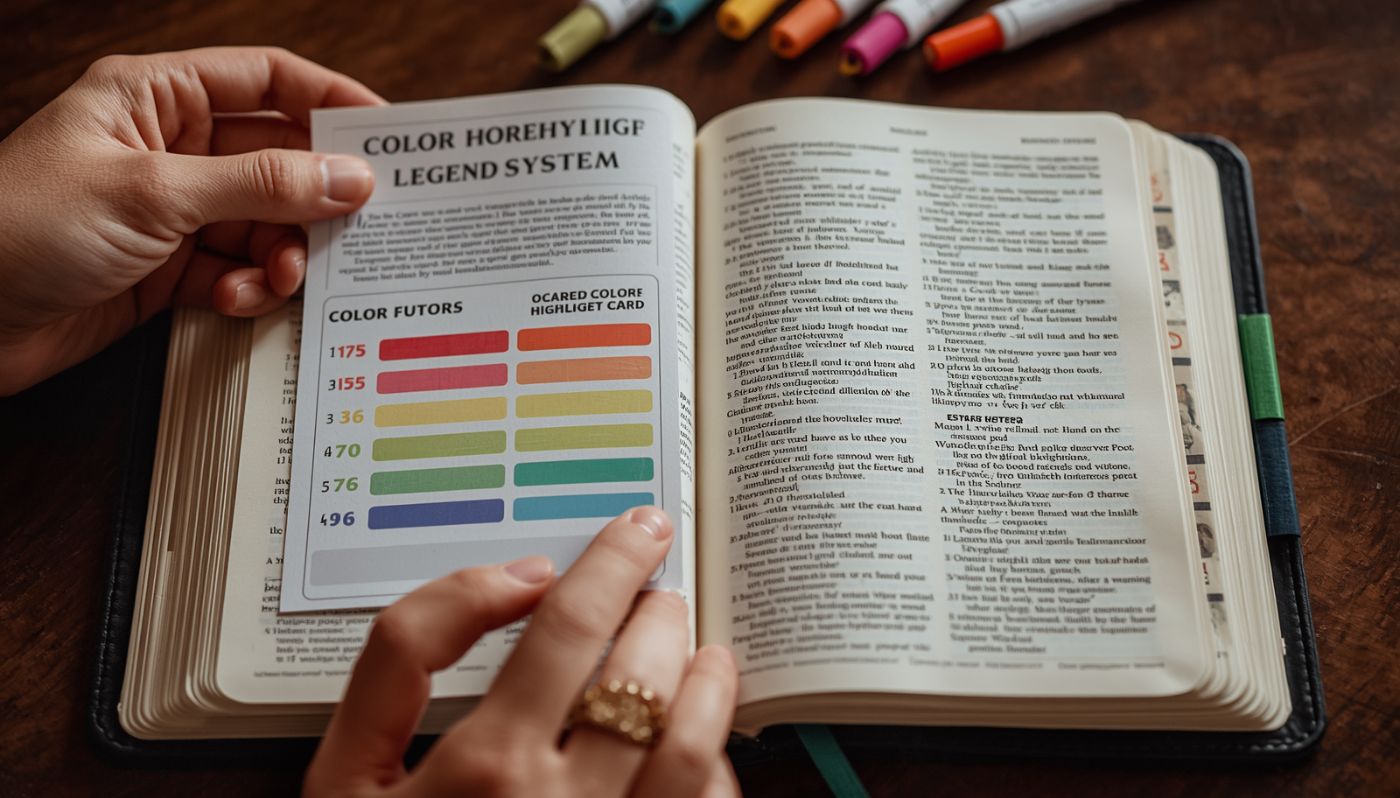
⦁ A color-code legend card — write it in the front of your Bible
Pro tip: Always test your highlighter on the last blank page of your Bible first. Check for bleed-through before using it on a real verse.
Which Bible Translation Is Best for Highlighting?
Any translation works! The ESV and NASB offer more word-for-word accuracy if you prefer deeper theological study.
🎨 The Best Bible Highlighting Color Systems Explained
What Is the Most Popular Bible Color-Coding System?
The most popular system uses 6–8 core colors, with each color representing a biblical theme. You consistently use the same color for the same type of verse throughout your entire Bible. Over time, flipping through your Bible becomes like reading a beautiful, personal commentary.
Here is the most widely used beginner color system:
COLOR THEME EXAMPLE VERSE TYPE
🟡 Yellow God’s Promises John 3:16, Romans 8:28 — verses about God’s faithfulness
🔵 Blue Peace & Prayer Philippians 4:6-7, Matthew 6:9-13 — prayer and comfort verses
🟢 Green Growth & New Life 2 Corinthians 5:17 — spiritual growth and renewal
🔴 Red / Pink Love & Sacrifice 1 Corinthians 13, John 15:13 — God’s love and grace
🟠 Orange Commands & Warnings Proverbs 3:5-6, Deuteronomy 6:5 — instructions to obey
🟣 Purple Prophecy & Royalty Isaiah 53, Revelation 19 — messianic and end-times themes
🩵 Light Blue Holy Spirit Acts 2, John 14:26 — references to the Spirit
🩷 Light Pink Faith & Trust Hebrews 11, James 1:3 — verses on trusting God
Can I Create My Own Custom Bible Color System?
Yes! Your personal color system is the most powerful one. If a color already means something to you, use it that way. The goal is consistency, not perfection. The true value comes from using the same color for the same theme every single time you open your Bible.
📝 Step-by-Step: How to Build Your Own Highlighting System
What Are the Steps to Start Bible Highlighting?
Follow these steps to build a system that truly works for you:
- Choose 6–8 colors you love and can easily find at any store.
- Assign one theme per color. Write a simple legend on an index card.
- Tape or glue that legend card inside the front cover of your Bible.
- Start with a single book — many beginners start with the Gospel of John or Psalms.
- As you read, highlight verses that move your heart using your assigned colors.
- Add a short note in the margin with a date or a one-word emotion.
- Review your highlights weekly — this doubles your retention dramatically.
- Expand your system over time as you discover new themes that matter to you.
The Inductive Bible Study method, developed by Kay Arthur at Precept Ministries International, uses this exact approach — observe, interpret, apply — with color marking as a central tool. It is one of the most respected Scripture study methods in evangelical Christianity today.
🌈 Color Code Ideas for Every Theme
What Colors Should I Use for Specific Bible Topics?
Here are additional color ideas beyond the basic system for readers who want to go deeper:
⦁ Gold / Tan — Names and attributes of God (Exodus 3:14, Isaiah 9:6)
⦁ Teal — Wisdom and knowledge (Proverbs 1:7, James 1:5)
⦁ Dark Green — Healing and miracles (Luke 17:14, John 9:7)
⦁ Dark Red — Sin and conviction (Romans 3:23, Isaiah 64:6)
⦁ Brown / Sepia — History and genealogy (Genesis 1, Matthew 1)
⦁ Gray — Lament and sorrow (Psalm 22, Lamentations 3)
How Do You Highlight Psalms and Proverbs?
Psalms and Proverbs are rich with emotion and wisdom. For Psalms, use your peace and comfort color for cries to God, and your promise color for every declaration of faith like “The Lord is my shepherd.” For Proverbs, your commands color works beautifully for the practical wisdom verses.
Many readers also use a second thin pen to underline key phrases within an already-highlighted verse — giving you two layers of meaning in one powerful verse.
🖊️ Best Highlighters for Bible Pages (No Bleed Guide)
Which Highlighters Do Not Bleed Through Bible Paper?
Bible paper is notoriously thin — usually 28–40 gsm. Regular highlighters will bleed straight through. Always use highlighters specifically made for thin paper. Here are the best options:
⦁ Zebra Mildliners — Water-based, dual-tip, gentle on thin pages. Best overall choice.
⦁ Pigma Micron Pens — Archival-quality for margin notes, zero bleed.
⦁ Sharpie Clear View Highlighters — See-through tip helps you highlight exactly.
⦁ Tombow Fudenosuke — Brush tip for beautiful calligraphy-style notes.
⦁ Staedtler Triplus Textsurfer — Slim body, water-based, nearly zero bleed.
Should You Use Pencils or Pens for Bible Margin Notes?
Pencils are erasable and forgiving — ideal for beginners who are not yet sure of their interpretation. Fine-point archival pens like the Pigma Micron are best for permanent notes you want to keep. However, never use ballpoint pens — the pressure can emboss or tear thin Bible paper.
⚠️ Common Mistakes to Avoid
What Are the Biggest Bible Highlighting Mistakes Beginners Make?
Even well-meaning readers fall into these traps. Avoid them from the start:
⦁ Highlighting too much — if everything is highlighted, nothing stands out. Aim for 20–30% of any page.
⦁ Using too many colors — more than 8 creates confusion, not clarity.
⦁ No legend — after 6 months you will forget what each color meant. Always write it down.
⦁ Choosing bleed-through highlighters — they destroy the Bible page and frustrate you.
⦁ Highlighting without reading first — read the full passage once, then go back and highlight.
⦁ Comparing your Bible to others — your system is personal. There is no right way, only your way.
Dr. Howard Hendricks, legendary professor at Dallas Theological Seminary, taught that over-marking is as dangerous as under-marking. “When you underline everything,” he wrote in Living by the Book, “you underline nothing.” Be selective. Be intentional. Be real.
🎓 Advanced Techniques for Deeper Bible Study
How Do You Combine Highlighting with Journaling?
Journaling pairs beautifully with highlighting. After marking a verse, write 2–3 sentences in a notebook or on the page margin: What does this verse mean? What does it mean for my life today? This simple practice transforms passive reading into active, heart-level meditation.
The SOAP method — Scripture, Observation, Application, Prayer — is a popular journaling framework used with highlighting. Many churches use this in their discipleship programs. It is one of the most effective spiritual growth tools available to any believer.
What Is the SWORD Bible Study Method?
The SWORD method (Scripture, What it says, Observe, Response, Determine) is an advanced tool for small group and personal study. Each letter represents an action step. Assign a highlight color to each step and watch your understanding of a passage explode with deep meaning.
How Do You Use Highlighting for Scripture Memorization?
Highlighting dramatically improves Scripture memorization. After highlighting a verse, trace your finger over it while reading it aloud three times. The combination of color, touch, and voice creates three separate memory pathways. According to learning science, multi-sensory input increases retention by up to 65%.
❓ People Also Ask — Answered
What is the best color to highlight Bible verses?
Yellow is the most popular choice for promises and key verses because it is bright and easy to see. However, the best color is the one you personally assign with intention. Consistency matters far more than the specific color you choose.
How do you organize your Bible with highlighters?
Start with a 6-color system: yellow for promises, blue for peace/prayer, green for growth, red for love, orange for commands, and purple for prophecy. Write your legend inside your front cover and stick to it every time you read.
Is it OK to write in your Bible?
Yes. Writing in, underlining, and highlighting your Bible is a deeply personal act of faith and engagement. Many theologians and pastors encourage it. A marked, worn Bible is a sign of a deeply lived faith, not disrespect.
How many colors should you use when highlighting the Bible?
Six to eight colors is the sweet spot for most readers. Fewer than six may not cover enough themes. More than eight becomes confusing and hard to remember. Start with six and add more only as you need them.
What Bible is best for highlighting and note-taking?
Wide-margin Bibles are ideal for note-taking alongside highlighting. Popular choices include the ESV Single Column Journaling Bible, the NIV Beautiful Word Bible, and the NLT Life Application Study Bible. All have slightly thicker paper and extra margin space.
Can you highlight a Bible on a tablet or app?
Yes! Apps like YouVersion, Logos, and Olive Tree all have digital highlighting features with custom color categories. Digital highlighting is perfect for travel or when you want to back up your notes to the cloud. However, many readers still prefer the tactile experience of physical highlighting.
✅ Conclusion: Your Bible Highlighting Journey Starts Today
A bible highlighting guide is more than a system — it is an invitation. An invitation to slow down, to see, and to deeply know the Word of God. With the right colors, the right tools, and a consistent approach, your Bible becomes the most personal book you will ever own.
You do not need a perfect system. You just need to start. Choose six colors. Open to the Gospel of John. Highlight one verse that moves your heart. That single act begins a true, lifelong Scripture study journey.
The most beautiful Bible on your shelf is the one with bent pages, worn edges, and colors that whisper: “I was here. God met me here.”
Did this guide help you?
Leave a comment below with your favorite color system, or share this article with a friend who is beginning their Bible study journey. We would love to hear how highlighting has changed your time in God’s Word!


