

Introduction:
Facing this decision for a loved one — or planning for yourself — often comes with more guilt than it should. Some people insist burial is the only option that honors God. Others worry that fire might somehow interfere with the resurrection. Scripture, though, is quieter on this than either camp assumes.
The Bible never forbids cremation, and it never commands burial as the only acceptable option either. What it focuses on instead is hope, respect for the body, and God’s unlimited power to raise His people regardless of what happened to their remains. This guide walks through what scripture actually says — in the KJV — the rare biblical cases involving burning, and how different Christian traditions have approached this decision.
Burial Was the Custom — But Was It a Command?
Burial is the practice you see throughout both Testaments — Abraham purchased land specifically to bury Sarah with dignity, Jacob and Joseph both requested burial in the promised land, and Joseph of Arimathea placed Jesus in a tomb. These accounts reflect genuine cultural respect, but Scripture never turns the custom into a binding law for every believer in every era.
“In the sweat of thy face shalt thou eat bread, till thou return unto the ground; for out of it wast thou taken: for dust thou art, and unto dust shalt thou return.” — Genesis 3:19
This verse, spoken to Adam, applies equally whether the body returns to dust slowly in the ground or more quickly through fire. It describes an outcome, not a method.
The Rare Biblical Cases of Burning
Scripture records only a handful of instances involving fire and human remains, and context changes the meaning of each one significantly.
“And when the inhabitants of Jabeshgilead heard of that which the Philistines had done to Saul; All the valiant men arose, and went all night, and took the body of Saul and the bodies of his sons from the wall of Bethshan, and came to Jabesh, and burnt them there. And they took their bones, and buried them under a tree at Jabesh, and fasted seven days.” — 1 Samuel 31:11-13
After the Philistines killed Saul and his sons and hung their bodies in disgrace, the men of Jabesh-Gilead burned the bodies to prevent further humiliation, then buried the bones with honor. David later praised this act — it’s treated as compassionate, not condemned.
In a very different case, Joshua 7 describes judgment falling on Achan after a serious sin against Israel.
“And Joshua said, Why hast thou troubled us? the LORD shall trouble thee this day. And all Israel stoned him with stones, and burned them with fire, after they had stoned them with stones.” — Joshua 7:25
Similarly, Amos condemns a foreign king for a very different reason:
“Thus saith the LORD; For three transgressions of Moab, and for four, I will not turn away the punishment thereof; because he burned the bones of the king of Edom into lime.” — Amos 2:1
Both of these involve judgment or contempt, not an ordinary funeral practice. Scripture doesn’t connect ordinary cremation today with either of these situations.
Does Cremation Affect the Resurrection?
Paul answers this concern directly, using an image that reframes the entire question.
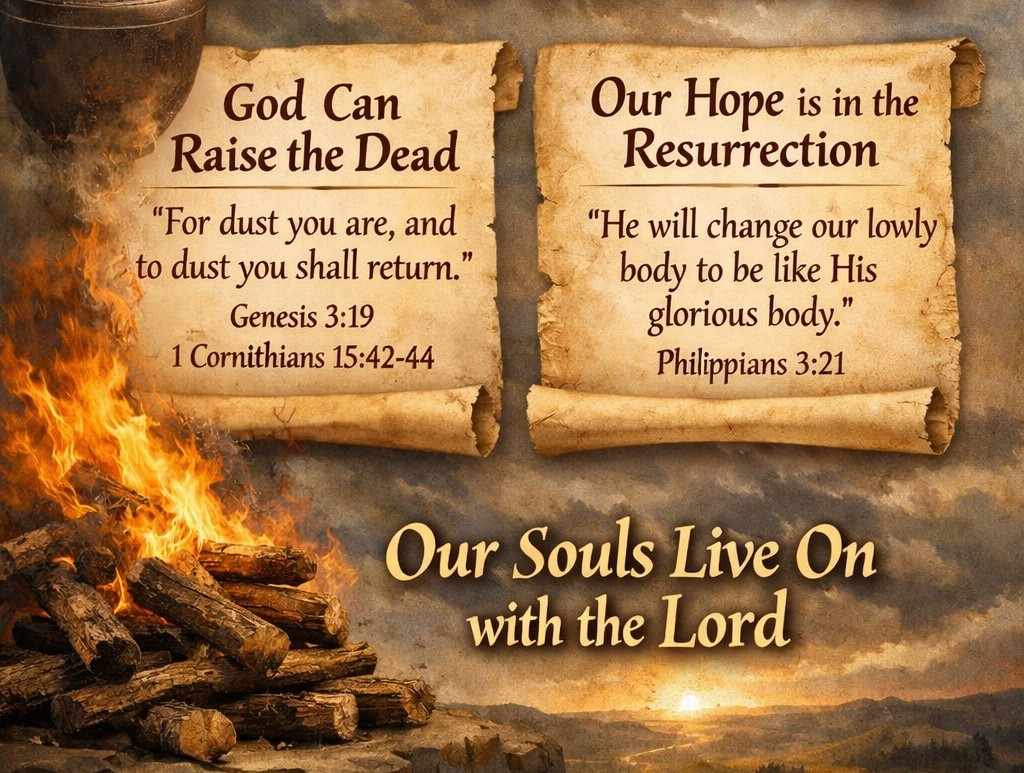
“So also is the resurrection of the dead. It is sown in corruption; it is raised in incorruption: It is sown in dishonour; it is raised in glory: it is sown in weakness; it is raised in power: It is sown a natural body; it is raised a spiritual body. There is a natural body, and there is a spiritual body.” — 1 Corinthians 15:42-44
Paul compares the body to a seed planted in the ground — it decays completely, yet God raises something new from it. Every body returns to dust eventually, whether through burial or cremation.
“Then shall the dust return to the earth as it was: and the spirit shall return unto God who gave it.” — Ecclesiastes 12:7
Jesus reinforces this same confidence in a different image entirely:
“And then shall he send his angels, and shall gather together his elect from the four winds, from the uttermost part of the earth to the uttermost part of heaven.” — Mark 13:27
No scattered remains limit that gathering. The same God who formed Adam from dust in the first place can recreate a glorified body from ashes anywhere on earth. This shifts the real question away from the method of disposition and toward trust in God’s power.
What Do Christian Traditions Say About Cremation Today?
Most Protestant and Evangelical traditions today treat cremation as a matter of personal freedom rather than doctrine. Billy Graham addressed this directly when asked whether cremation could bar someone from heaven:
“No, this isn’t what the Bible says, and I find nothing in the Bible that forbids cremation as a means of disposing of a person’s body.”
The Roman Catholic Church took longer to formally permit it. The Church’s 1917 Code of Canon Law had prohibited cremation, largely as a reaction to groups using it to publicly deny the resurrection. The Holy Office lifted that restriction in 1963, and the Vatican’s 2016 instruction Ad resurgendum cum Christo added further guidance: cremated remains should still be treated with the same reverence as a body, kept in a sacred place like a cemetery or columbarium rather than scattered or kept at home.
The Eastern Orthodox Church takes the strictest position of the three, generally discouraging cremation and preferring burial as an expression of the body’s role as a temple of the Holy Spirit — though some jurisdictions permit it under extraordinary circumstances.
Addressing Common Worries
Some people worry that cremation mirrors pagan practice or disrespects the body as God’s temple. Scripture never makes either concern a binding rule for believers today — ancient cultures practiced both burial and cremation, and the biblical emphasis falls on how a person lives in the body, not on what happens to it afterward.
Financial and environmental factors are legitimate parts of this decision too. Cremation typically costs less and uses less land. Churches increasingly provide columbaria or memorial support for families who choose it. Scripture leaves room for exactly this kind of practical wisdom.
“One man esteemeth one day above another: another esteemeth every day alike. Let every man be fully persuaded in his own mind.” — Romans 14:5
This principle of grace in disputable matters applies well here — pray it through, talk with family, and choose what brings genuine peace rather than guilt.
Steps for Making This Decision
- Read the relevant passages together as a family — Genesis 3:19, 1 Samuel 31, and 1 Corinthians 15 are a good starting point.
- Talk openly about cost, family wishes, and the emotions involved, rather than avoiding the conversation.
- Bring the decision to a pastor or trusted spiritual leader for guidance specific to your situation.
“If any man of you lack wisdom, let him ask of God, that giveth to all men liberally, and upbraideth not; and it shall be given him.” — James 1:5
- Plan a memorial service that points toward Jesus and the resurrection hope, regardless of which option is chosen.
- If cremation is chosen, decide on a respectful way to handle the ashes that fits the family’s story — burial, a columbarium, or another meaningful, permanent place.
FAQ Section
Q1: Does the Bible call cremation a sin?
No — the Bible never labels cremation as sin and gives no direct command for or against the practice, leaving believers free to decide with a clear conscience.
Q2: Will God resurrect someone who was cremated?
Yes — 1 Corinthians 15:42-44 describes resurrection as God raising an entirely new, glorified body, a power that isn’t limited by what happened to the physical remains.
Q3: Why does the Bible mostly show burial rather than cremation?
Burial reflected the common cultural practice of the time and showed respect for the dead, but Scripture presents it as a custom rather than a divine law required in every era.
Q4: What did the Catholic Church historically teach about cremation?
The Catholic Church prohibited cremation under the 1917 Code of Canon Law, largely in response to groups using it to deny the resurrection publicly. That restriction was lifted in 1963, and a 2016 Vatican instruction added guidance on treating cremated remains with continued reverence.
Q5: Does cremation dishonor the body as God’s temple?
That teaching applies to how a person lives in and cares for their body while alive. After death, scripture’s focus shifts to dignity for the remains and trust in the resurrection, regardless of the method chosen.
Q6: Should cost or environmental impact influence the decision?
Yes — scripture allows room for practical stewardship, and many families weigh affordability and environmental impact alongside their faith convictions without compromising either.
Final Thoughts
What the Bible says about cremation is, in the end, an invitation to freedom rather than fear. Either choice can honor the dead and comfort the living. Scripture offers no prohibition here — only the deeper hope that God redeems every detail, including the ones we can’t control. Families tend to find the most peace when the focus shifts from debating method to simply celebrating a life lived in Christ.


