

Introduction: Bible Verses About Hope, Direction, and God’s Guidance
Feeling lost is one of the most searched spiritual struggles among Christians in 2026 — and scripture has a direct answer. When you feel lost, the Bible offers more than comfort; it provides specific guidance for identity confusion, spiritual disconnection, and loss of direction that no motivational quote can replace. These are not generic verses pulled from a list — they are organized by the exact type of lostness you may be experiencing right now.
Research consistently shows that purposelessness and quiet emotional drift affect millions of believers whose lives appear stable from the outside. This guide presents 30 carefully selected Bible verses across three distinct emotional categories, so you find the scripture that speaks precisely to where you are — not where someone in a more obvious crisis might be. Whether you are spiritually drifting, questioning your identity, or simply unsure of your next step, these verses meet you there.
Bible Verses for When You’ve Lost Your Sense of Identity
Identity confusion is one of the most disorienting forms of lostness — not knowing who you are, who you’re becoming, or whether the person you’ve been is still who you want to be.
Psalm 139:13-16 — Known Before You Knew Yourself
Psalm 139:13-16 is one of the most directly identity-affirming passages in scripture. Verse 14 — “I am fearfully and wonderfully made” — is widely quoted, but the surrounding verses add important depth: God is described as having “knit” the psalmist together, as knowing all their days before any of them came to be, and as seeing them even in the earliest, most unformed stage of existence.
For someone in an identity crisis, the significance of this passage is that it frames identity not as something constructed through achievement or social validation, but as something already established before either of those things existed. You don’t become known by becoming something — you were known first.
Galatians 2:20 — Reframing Who You Are in Christ
Galatians 2:20 — “I have been crucified with Christ and I no longer live, but Christ lives in me” — addresses identity at a foundational level, offering a reorientation of self that isn’t dependent on circumstances, relationships, or performance. For someone who has defined themselves primarily through a role (parent, professional, partner) and suddenly feels that role slipping, this verse offers an identity underneath all of those — one that doesn’t change when external roles do.
Ephesians 1:4-5 — Chosen Before the Foundation of the World
Ephesians 1:4-5 describes believers as having been “chosen” before the world was created, “in love,” and “in accordance with his pleasure and will.” This verse is worth sitting with slowly during an identity crisis, because it locates worth in a decision made before time — entirely outside of anything the reader has done, succeeded at, or failed to become.
Bible Verses for When You Feel Spiritually Disconnected
Spiritual disconnection — that experience of God feeling distant, prayers feeling hollow, or faith feeling like something you remember having but can’t quite locate right now — is addressed more directly in scripture than many readers realize.
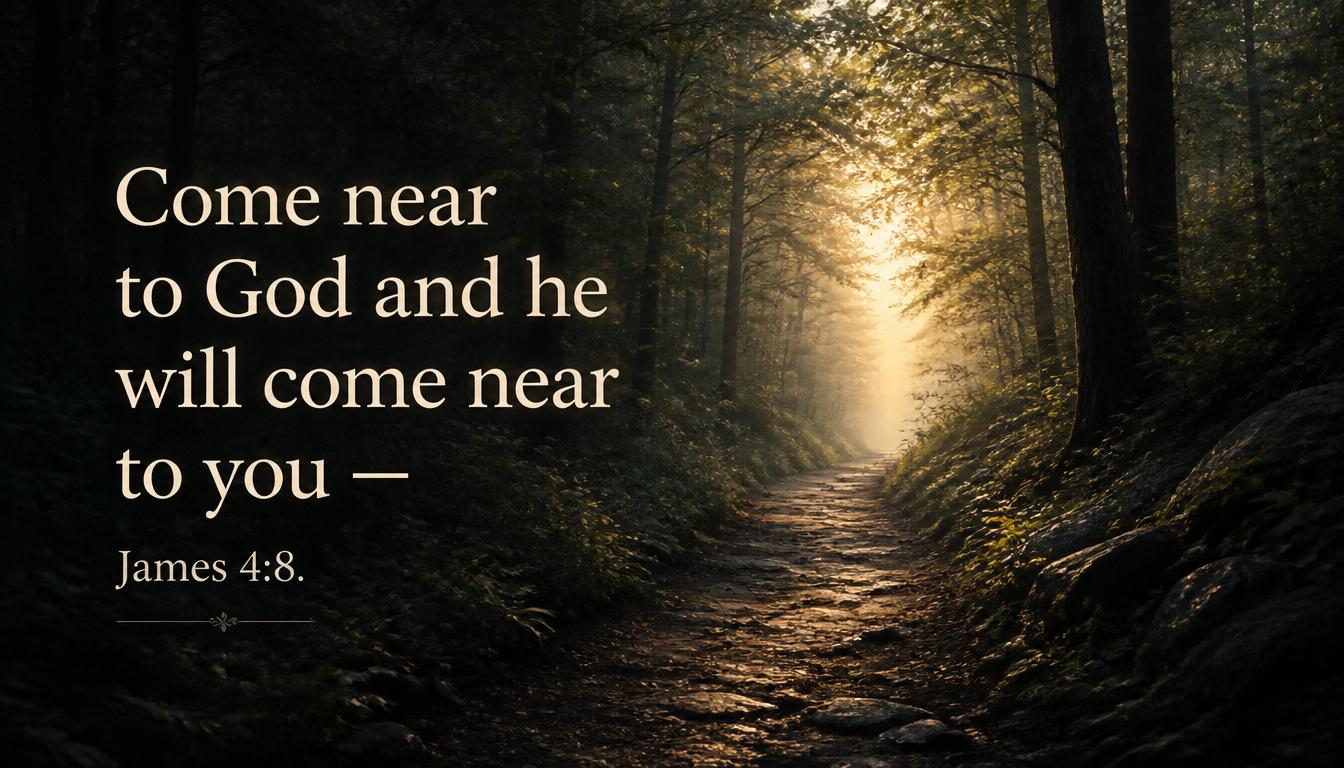
James 4:8 — A Promise That Works in Both Directions
James 4:8 — “Come near to God, and he will come near to you” — is one of the most practically useful verses for spiritual disconnection because of its structure: it’s a conditional promise with an achievable first step. The distance isn’t permanent, and closing it doesn’t require an emotional breakthrough — it requires movement, however small.
Many readers in spiritually dry seasons find this verse helpful precisely because it doesn’t require feeling close to God before acting. The verse doesn’t say “feel near to God” — it says “come near,” which is something that can be done regardless of how things feel.
Luke 15:4-6 — God Goes After the Lost One
Luke 15:4-6 describes a shepherd leaving ninety-nine sheep to find the one that is lost — then returning with it “joyfully.” For someone who feels spiritually adrift, the most significant detail in this parable is the initiative: it’s the shepherd who searches, not the sheep who finds its own way back. The one that is lost doesn’t navigate home alone; it gets found.
This reframes spiritual reconnection not as something achieved through sufficient spiritual effort, but as something God is actively working toward — even when the person feels too far gone to try.
Hosea 6:1 — An Invitation Back, Not a Punishment
Hosea 6:1 — “Come, let us return to the Lord. He has torn us to pieces but he will heal us; he has injured us, but he will bind up our wounds” — uses surprisingly direct language about the pain of spiritual distance before pivoting to the promise of return and healing. For readers who feel spiritually lost and also carry some guilt about it, this verse acknowledges both the difficulty and the pathway back, without minimizing either.
Bible Verses for When You’ve Lost Your Sense of Direction or Purpose
Purposelessness is a specific kind of lostness — not a crisis of faith or identity necessarily, but a quieter question: what am I actually doing, and does it matter?
Jeremiah 29:11 — Purpose Embedded in the Promise
Jeremiah 29:11 — “For I know the plans I have for you… plans to give you hope and a future” — speaks directly into purposelessness because it makes clear that God’s awareness of your situation doesn’t depend on your own awareness of where you’re going. The verse is addressed to a people who had lost their normal context entirely — their city, their temple, their routines — and yet the promise of purpose remained intact regardless.
For someone going through the motions without a clear sense of why, this verse reframes the question: direction doesn’t have to feel visible to exist.
Proverbs 16:9 — Planning Without Paralysis
Proverbs 16:9 — “In their hearts humans plan their course, but the Lord establishes their steps” — offers a practical balance between taking action and trusting direction. It doesn’t say planning is pointless; it says the final direction of those plans is held by something larger than personal strategy alone.
For someone paralyzed by indecision or the fear of choosing wrongly, this verse can be genuinely liberating — it suggests moving forward with available information while trusting that course corrections come from outside the planner.
Romans 8:28 — Purpose Working Through, Not Around, Confusion
Romans 8:28 — “we know that in all things God works for the good of those who love him” — reframes purposelessness by suggesting that even the confusing, directionless seasons are being worked through, not wasted. The phrase “in all things” is significant: it includes unclear seasons, not just obvious turning points.
If purposelessness connects to a bigger anxiety about what your future holds, our guide on Bible verses about hope for the future explores that forward-looking dimension in more depth.

Sometimes feeling lost is compounded by isolation — the sense that not only do you not know where you’re going, but you’re navigating it without anyone who truly understands.
Psalm 23:3-4 — A Shepherd in Dark Valleys
Psalm 23:3-4 is one of the most memorized passages in scripture, and its relevance to feeling lost and alone is built into the imagery itself: a valley, darkness, and a shepherd who is nonetheless with the traveler.
Deuteronomy 31:8 — God Goes Before and Beside
Deuteronomy 31:8 — “The Lord himself goes before you and will be with you; he will never leave you nor forsake you. Do not be afraid; do not be discouraged” — pairs forward movement (goes before) with present company (will be with you) in a single promise. For someone feeling both directionally lost and alone in it, this verse addresses both dimensions without requiring either to be resolved first.
Isaiah 43:1-2 — Called by Name, Not by Situation
Isaiah 43:1-2 begins with a striking phrase: “Do not fear, for I have redeemed you; I have summoned you by name; you are mine.” The specificity of being called “by name” is significant — not called by category, not called as part of a group, but named, which is the most personal form of being known.
How to Find Your Way Through Scripture When You Feel Too Lost to Know Where to Start
The irony of feeling lost is that it can make it hard to even begin — every verse list looks the same, every devotional feels generic, and the effort of reading anything at all seems like more than you have.
Start With One Verse, Not a Collection
When everything feels heavy, starting with all thirty verses on a list is counterproductive. Choose one — ideally from the section above that most closely matches your specific flavor of lostness — and read only that one for several days. Depth with one verse does more work than exposure to many.
Use the Verse as a Question, Not Just a Statement
Rather than reading a verse and waiting for it to produce a feeling, try turning it into a question: “What would it mean for my soul to actually be restored today?” or “What would it look like to take one step near to God this week?” This shifts the verse from information to active engagement.
Say It Out Loud, Especially When It Doesn’t Feel True
What we’re seeing now is readers using scripture as a spoken practice — reading verses aloud, especially the ones that feel least believable, as a way of letting words shape feeling rather than waiting for feeling to validate words. This is an ancient practice with modern psychological support: language shapes emotional experience, not just reflects it.
For a complete foundation on how love and hope work together throughout scripture, explore our full guide to Bible verses about love and hope.
Frequently Asked Questions
Q: What is the best Bible verse for when you feel lost?
A: Psalm 23:3 — “He restores my soul; he guides me along the right paths” — is among the most widely cited, addressing both the inner restoration and the practical guidance that feeling lost requires. It frames God as actively involved in both dimensions simultaneously.
Q: What does Jesus say about people who feel lost?
A: Luke 15:4-6 describes a shepherd leaving ninety-nine sheep to search specifically for the one that is lost — and returning with it joyfully.
Q: What Bible verse helps with feeling spiritually disconnected?
A: James 4:8 — “Come near to God and he will come near to you” — is among the most practically useful, because it frames reconnection as achievable through a small, actionable first step rather than requiring an emotional breakthrough to precede action.
Q: Is there a Bible verse for feeling purposeless or without direction?
A: Jeremiah 29:11 reassures that God’s plans include “hope and a future,” even during seasons when no clear direction is visible — written originally to people who had lost their normal context entirely, making it directly applicable to purposelessness.
Q: What scripture speaks to feeling lost and alone at the same time?
A: Isaiah 43:1-2 addresses both dimensions — being known personally (“I have summoned you by name”) and not being left alone in difficulty (“when you pass through the waters, I will be with you”). It pairs identity affirmation with a presence promise in a single passage.
Q: How can I use these verses when I’m too low to engage with scripture?
A: Start with one verse from the section that most closely matches your type of lostness, rather than a full list. Read it aloud, even when it doesn’t feel true, and turn it into a question you sit with — not a statement you must immediately believe. Small engagement is still engagement.
End-of-article CTA:
Feeling lost isn’t a sign that something has gone permanently wrong with you or your faith — it’s one of the most honestly human experiences scripture describes, and one of the ones it speaks most directly into. Start with one verse from whichever section felt closest to where you are. Read it slowly, more than once. Let it be enough for today. And when you’re ready to explore how love and hope work together as a foundation for finding your way, our full guide to Bible verses about love and hope is a natural next step.


