
Introduction:
The Glory Be is one of the shortest prayers in Christianity — and one of the most repeated. Also known as the Gloria Patri, this trinitarian doxology has been prayed for over 1,600 years, from the early desert monks to Catholic, Anglican, and Lutheran congregations today. It closes every psalm in the Liturgy of the Hours, follows each decade of the Holy Rosary, and appears throughout daily liturgical worship across denominations.
This guide walks through the full Glory Be Prayer text, what each line actually means, its origin tied to the Council of Nicaea, and exactly how it’s used in daily Catholic prayer life — including where it fits in the Rosary and how it connects to the Fatima Prayer.
What Exactly Is the Glory Be Prayer?
The Glory Be is a trinitarian doxology — a short, fixed formula of praise honoring God as three Persons in one being. The word “doxology” comes from the Greek doxa (glory) and logos (word) — literally, “a word of glory.” It doesn’t ask for anything, confess sin, or intercede for anyone. It simply glorifies God, which is exactly what makes it distinct from most other Catholic prayers.
Catholics, Anglicans, Lutherans, and several other Christian traditions pray it daily. It appears in the Liturgy of the Hours, at the end of every psalm, and most visibly in the Holy Rosary after each decade.
The Full Glory Be Prayer in English
Here is the complete, standard Glory Be Prayer used across Catholic communities in the English-speaking world:
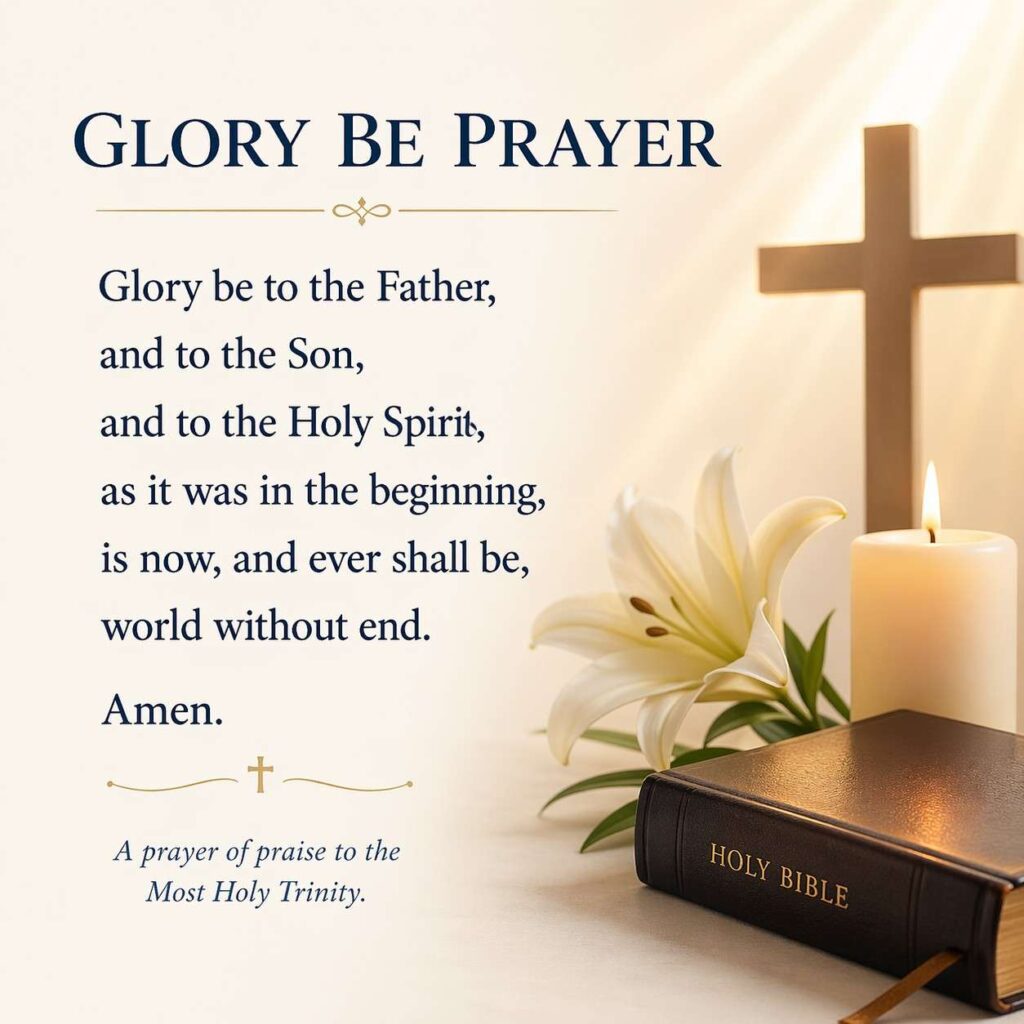
“Glory be to the Father, and to the Son, and to the Holy Spirit. As it was in the beginning, is now, and ever shall be, world without end. Amen.”
Two sentences. Thirty-three words. And centuries of theological weight packed into every line.
The Latin Version — Gloria Patri
The original Latin, still sung in formal liturgical settings, reads:
Gloria Patri, et Filio, et Spiritui Sancto. Sicut erat in principio, et nunc et semper, et in saecula saeculorum. Amen.
Many traditional Catholic communities and those who attend the Traditional Latin Mass still prefer this form — not out of nostalgia, but because it connects modern worship directly to the language of the early Church.
What Does the Glory Be Prayer Mean, Line by Line?
Understanding each phrase is what separates reciting the words from actually praying them.
“Glory be to the Father, and to the Son, and to the Holy Spirit.”
This opening line addresses all three Persons of the Trinity together, not one at a time. The Catechism of the Catholic Church describes the Trinity this way:
“The mystery of the Most Holy Trinity is the central mystery of Christian faith and life.” — CCC 234
By naming Father, Son, and Holy Spirit in a single breath of praise, the prayer affirms both the distinctness and the equal divinity of the three Persons — trinitarian worship in its most compact form.
“As it was in the beginning, is now, and ever shall be.”
This phrase places God’s glory outside of time entirely. It existed before creation, exists in this present moment, and continues beyond the end of all things. Praying it means joining a stream of worship that stretches in both directions — not just praying for yourself today, but adding your voice to something far older and larger.
“World without end. Amen.”
“World without end” translates the Latin in saecula saeculorum — more literally, “unto the ages of ages,” a way of expressing a duration beyond ordinary language. “Amen,” from the Hebrew for truth or “so be it,” seals the prayer as sincere and meant.
The History of the Glory Be: Ancient Roots, Living Tradition
The Glory Be didn’t appear from nowhere. Doxological formulas — short expressions of praise to God — trace back to the earliest generations of the Church, inherited in part from Jewish liturgical practice.
The trinitarian form used today was shaped specifically in response to the Arian controversy of the 4th century. Arius and his followers taught that the Son was a created being, subordinate to the Father rather than eternally divine. The Council of Nicaea (325 AD) firmly rejected this, affirming the Son’s full and equal divinity.
In direct response to Arius’s teaching, the phrase “as it was in the beginning” was added to the doxology to make a specific theological point: the Son’s glory didn’t begin at creation — it has always existed, coequal with the Father. Every time the Glory Be is prayed, it’s a small reaffirmation of that ancient, settled orthodoxy.
By the Middle Ages, the Gloria Patri had become a fixed element of the Divine Office — what’s now called the Liturgy of the Hours — prayed at the close of every psalm, multiple times a day. Monks recited it dozens of times before sunrise.
How to Pray the Glory Be: A Practical Guide
Step 1 — Pause. Take one slow breath before beginning. Become aware that you’re in God’s presence right now, in this specific moment.
Step 2 — Sign of the Cross (optional). Many Catholics begin the prayer this way as part of a broader devotional practice, though it isn’t required outside of formal liturgical settings.
Step 3 — Speak it slowly. Say each phrase with attention rather than speed: “Glory be to the Father, and to the Son, and to the Holy Spirit. As it was in the beginning, is now, and ever shall be, world without end. Amen.”
Step 4 — Rest briefly. After “Amen,” don’t rush. Let the praise settle for a moment before moving on.
Step 5 — Use it as a transition. The Glory Be works well at the end of a psalm, between Rosary decades, after morning prayer, or even at the close of a difficult conversation — it reorients the heart toward God quickly.
The Glory Be in the Rosary — Where It Fits
Most Catholics encounter the Glory Be most regularly through the Holy Rosary. After ten Hail Marys in each decade, the decade concludes with the Glory Be — and in most Marian devotions, the Fatima Prayer follows immediately after.
A single Rosary decade follows this structure:
- Announce the Mystery
- Our Father (once)
- Hail Mary (ten times)
- Glory Be (once)
- Fatima Prayer (once)
The Fatima Prayer — “O my Jesus, forgive us our sins, save us from the fires of hell, lead all souls to heaven, especially those who have most need of Thy mercy” — was given to three shepherd children at Fátima, Portugal, in 1917. Our Lady specifically requested it be added after the Glory Be at the end of each decade. The Glory Be lifts the decade in pure praise; the Fatima Prayer follows as a prayer of reparation and mercy.
In a full five-decade Rosary, the Glory Be is prayed five times. Across all twenty mysteries — including the Luminous Mysteries added by Pope Saint John Paul II in 2002 — it’s recited twenty times.
Are There Modern Translations of the Glory Be?
Some prayer books offer updated language for contemporary readers — for example, rendering “world without end” as “forever and ever,” a more accessible phrasing for younger or newer believers. Both are equally valid renderings of the Latin in saecula saeculorum. The theological meaning doesn’t change, only the vocabulary.
If you attend a more contemporary parish, don’t be surprised by slightly different wording. What matters is the intent behind it — praise offered to the Triune God, unchanged regardless of the century of translation.
Why the Glory Be Matters
I’ll be honest: for a long time, praying the Rosary meant treating the Glory Be as the brief exhale between the “real” prayers — something to get through before the next Hail Mary. Sitting with its history and theology changed that.
What the Glory Be does, spiritually, is train the heart in pure praise. Unlike the Our Father, which includes petitions, or the Hail Mary, which includes intercession, the Glory Be asks for nothing at all. It’s entirely self-giving — honor offered with no requests attached. The Catechism connects memorized, repeated prayers like this one to genuine spiritual formation over time, not empty repetition, provided the meaning behind the words is actually understood rather than glossed over.
Prayers of request tend to keep our own needs at the center. A prayer of pure praise shifts the center back to God.
FAQ Section
Q1: Is the Glory Be Prayer only used in Catholic worship?
No — while it’s deeply embedded in Catholic liturgical life and the Rosary, Anglicans include it in morning and evening prayer, Lutherans use it in worship, and Eastern Orthodox Christians pray similar doxological forms. It’s best described as a broadly Christian prayer with especially strong roots in Catholic practice.
Q2: Why does my prayer book have slightly different wording for the Glory Be?
Translations vary by denomination, era, and region — some say “world without end,” others use “forever and ever.” These are valid renderings of the same Latin original; the differences are linguistic, not theological.
Q3: Can I teach the Glory Be to my children?
Yes — because it’s short and theologically rich, it’s often one of the first prayers taught to young children, alongside the Sign of the Cross. The Catechism encourages introducing short, memorized prayers early, provided their meaning is explained rather than left as rote repetition.
Q4: How does the Glory Be connect to the Fatima Prayer?
In the Rosary, the Fatima Prayer immediately follows the Glory Be at the end of each decade, a sequence requested by Our Lady of Fátima in 1917. The Glory Be offers pure praise; the Fatima Prayer offers reparation and intercession.
Q5: Does the Glory Be appear in the Bible?
The exact wording doesn’t appear in scripture, but its content is thoroughly biblical — trinitarian doxologies appear throughout the New Testament, including Romans 16:27, Galatians 1:5, and Revelation 1:6. The prayer is best understood as a liturgical crystallization of biblical praise rather than a direct quotation.
Final Thoughts
The Glory Be may be the smallest prayer in regular Catholic devotion, but it carries more weight than its length suggests. From its roots in the early Church’s response to the Arian controversy, to its place at the close of every Rosary decade, this brief doxology has shaped Christian prayer for over sixteen centuries.
Whether you’re learning it for the first time or returning to a lifelong practice, the invitation stays the same: slow down, mean the words, and let pure praise do what a request never quite can. Glory belongs to the Father, and to the Son, and to the Holy Spirit — now and always.


