
Introduction:
Most of us have been there — staring at an overdue bill, sitting in a hospital waiting room, or lying awake wondering how something will possibly work out. In those raw moments, theology stops being abstract. You don’t want a lecture. You want to know: is God actually paying attention?
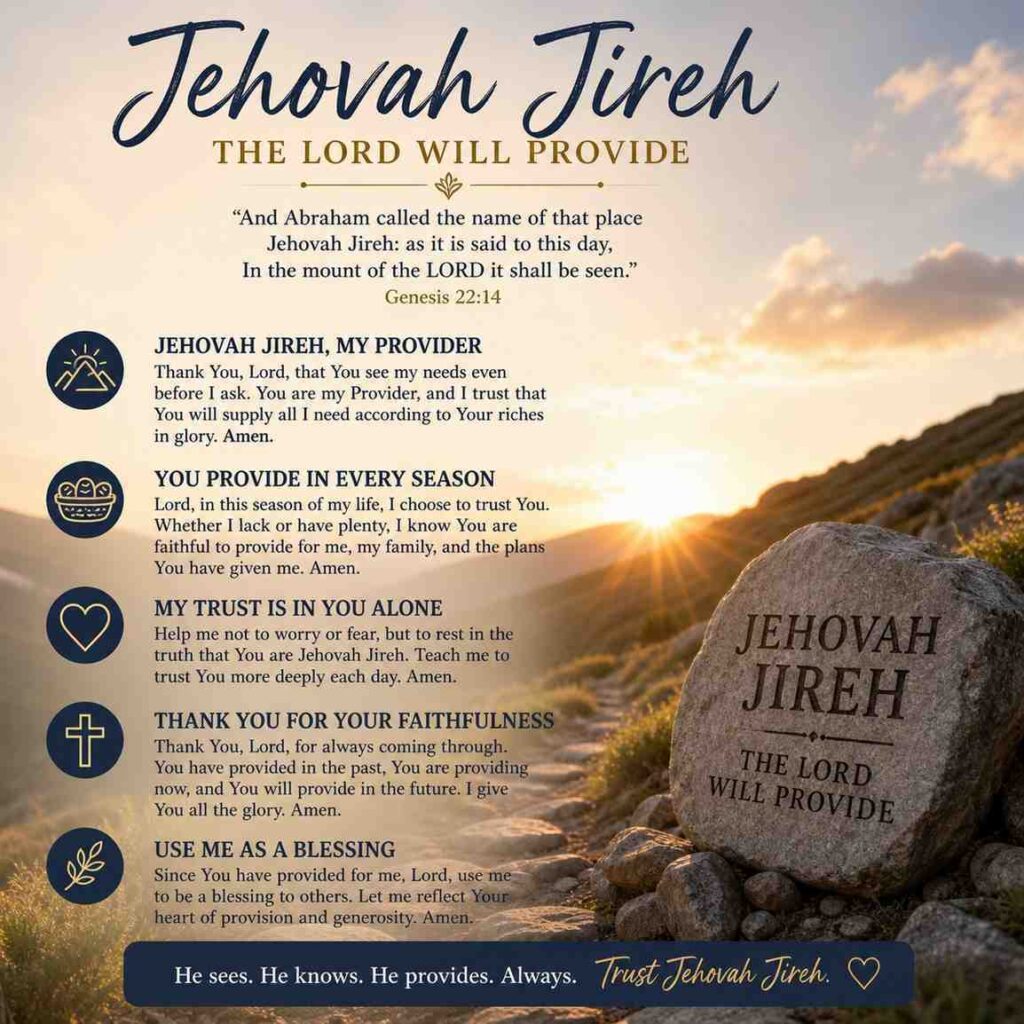
Scripture answers that question through one of its oldest names for God. Jehovah Jireh, meaning “The Lord Will Provide,” was declared by Abraham on Mount Moriah after God supplied a ram at the last possible moment (Genesis 22:14). A related name, Jehovah Nissi — “The Lord Is My Banner” — was proclaimed by Moses after a battlefield victory in Exodus 17:15. Together, in the KJV, these names describe a God who meets both provision and battle — not from a distance, but as present help.
What Does Jehovah Jireh Mean in Hebrew?
Jehovah Jireh literally translates as “The Lord Will Provide,” though the Hebrew carries more than the English lets on. The word comes from the root ra’ah, meaning “to see,” and it combines seeing with acting — God’s awareness of a situation and His provision for it are described as the same movement, not two separate steps.
“And Abraham called the name of that place Jehovahjireh: as it is said to this day, In the mount of the LORD it shall be seen.” — Genesis 22:14
In the ancient world, a king who “saw” someone’s suffering was already expected to respond — seeing carried an obligation attached to it. That’s the picture behind this name: God’s awareness of your situation isn’t separate from His response to it.
The Story Behind the Name (Genesis 22)
Genesis 22 is one of the most emotionally intense passages in Scripture. God instructs Abraham — a man who had waited decades for a son — to offer that son, Isaac, on Mount Moriah. Abraham doesn’t argue or delay. He climbs the mountain, trusting that God would somehow make a way.
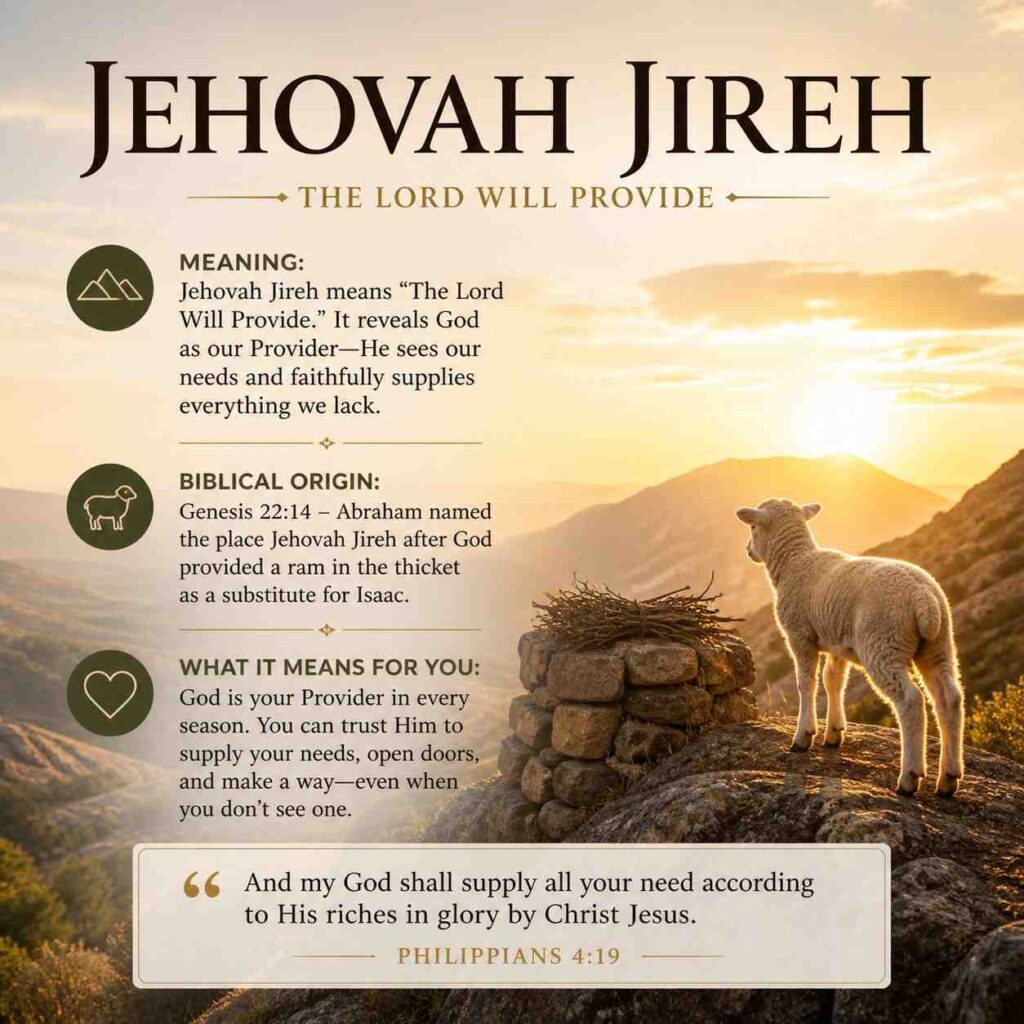
A ram is caught in a nearby thicket. Abraham offers it in Isaac’s place and names the mountain Jehovah Jireh, embedding the testimony into the place itself.
What’s easy to miss in this story: the provision arrived after the act of trust, not before. Abraham didn’t see the ram first and then decide to trust — he trusted, and the ram appeared. That’s the order the name itself preserves.
Jehovah Jireh Throughout Scripture
While the specific name Jehovah Jireh appears only once, in Genesis 22:14, the same pattern of God’s provision shows up throughout the rest of the Bible.
“But my God shall supply all your need according to his riches in glory by Christ Jesus.” — Philippians 4:19
This verse ties provision to God’s own resources, not to what looks realistic from a human budget.
“Therefore, take no thought, saying, What shall we eat? Or, what shall we drink? or, Wherewithal shall we be clothed?… But seek ye first the kingdom of God, and his righteousness; and all these things shall be added unto you.” — Matthew 6:31, 33
Jesus frames provision as something that follows seeking God first, rather than something earned through worry or self-sufficiency.
What Does Jehovah Nissi Mean?
Jehovah Nissi translates as “The Lord Is My Banner” — or more directly, “the Lord is my rallying point.” The Hebrew word comes from a root meaning a pole or standard raised for troops to rally around in battle.
“And Moses built an altar, and called the name of it Jehovahnissi.” — Exodus 17:15
In the ancient world, a battle standard announced that a king or commander was present and fighting alongside the army. To fight under someone’s banner meant fighting under their authority and protection.
The Battle Behind the Name (Exodus 17)
Exodus 17 records Israel’s first military conflict after leaving Egypt — the Amalekites attack a newly freed, exhausted people in the desert.
“And it came to pass, when Moses held up his hand, that Israel prevailed: and when he let down his hand, Amalek prevailed. But Moses’ hands were heavy; and they took a stone, and put it under him, and he sat thereon; and Aaron and Hur stayed up his hands, the one on the one side, and the other on the other side; and his hands were steady until the going down of the sun.” — Exodus 17:11-12
The theology here is unusually honest: the victory wasn’t won by superior strategy but by sustained dependence — the moment Israel’s posture shifted toward self-sufficiency, they lost ground. Moses raises an altar afterward and calls it Jehovah Nissi. The victory belonged to the One whose name flew over the field, not to Israel’s own strength.
How Jehovah Jireh and Jehovah Nissi Work Together
These two names aren’t separate categories — they describe two dimensions of the same relationship. Jehovah Jireh speaks to need: scarcity, lack, financial pressure. Jehovah Nissi speaks to battle: opposition, struggle, spiritual warfare. Together, they describe a God who sees your lack and also fights your battles.
It’s easy to remember Jehovah Jireh when the rent is due, but forget Jehovah Nissi when the anxiety won’t lift, or the situation won’t resolve. Scripture presents both names as inviting the same posture — trust, and something like Moses’ lifted hands: staying in a position of dependence rather than trying to force an outcome alone.
What This Means in Practice
Scripture doesn’t just record these names as historical footnotes — it presents them as something believers are meant to actually call on. When facing financial lack, calling on Jehovah Jireh isn’t a formula; it’s an act of naming who God is in relation to a specific need. When facing opposition — anxiety, conflict, something that feels like spiritual warfare — Jehovah Nissi is the same kind of act, lifting the situation to God rather than trying to carry it alone.
“If any of you lack wisdom, let him ask of God, that giveth to all men liberally, and upbraideth not; and it shall be given him.” — James 1:5
The pattern across all of these verses is consistent: need is brought honestly, not hidden or minimized, and the response comes from God’s character rather than the size of the problem.
Prayers to Pray Using These Names of God
These aren’t formulas — they’re a starting point. Use your own words alongside them.
For Financial Provision (Jehovah Jireh)
Jehovah Jireh, You see my finances — the bills I can’t pay, the gap between what I earn and what I owe. I trust You not because circumstances look hopeful, but because You are the God who provides. Open doors I cannot see. I bring You my lack, and I trust You with the outcome. Amen.
For Battles and Opposition (Jehovah Nissi)
Jehovah Nissi, I am tired of fighting this in my own strength. I lift this situation and declare that it belongs to You — whatever it is I’m facing that feels bigger than I can carry alone. You are my Banner. I choose dependence over self-sufficiency today. Amen.
For Wisdom and Direction
Lord, provide clarity where I see only fog. As Jehovah Jireh, You supply what I lack, and right now I lack wisdom. According to Your promise in James 1:5, I ask boldly and trust You to answer. Amen.
4. FAQ Section
Q1: Is Jehovah Jireh only about financial provision?
No — the Hebrew concept behind the name covers every category of need, not just money. While financial provision is the most commonly cited application, the name applies equally to peace in anxiety, wisdom in confusion, and healing in illness.
Q2: What is the difference between Jehovah Jireh and Jehovah Nissi?
Jehovah Jireh focuses on God as provider — the One who sees lack and supplies what’s needed. Jehovah Nissi focuses on God as protector — the One who fights battles and secures victory. Jehovah Jireh covers your needs; Jehovah Nissi covers your opposition.
Q3: How do you pronounce Jehovah Jireh and Jehovah Nissi?
Jehovah Jireh is pronounced jih-HO-vah JI-reh, with the second syllable of Jireh rhyming with “ray.” Jehovah Nissi is pronounced jih-HO-vah NIS-ee.
Q4: Can I use these names of God in daily prayer?
Yes — calling on a specific name of God in prayer isn’t a formula or superstition; it’s a way of anchoring a specific need to a specific aspect of God’s character, as Abraham and Moses both did in the original accounts.
Q5: Where do these names appear in the Bible?
Jehovah Jireh appears explicitly in Genesis 22:14, after Abraham’s test on Mount Moriah. Jehovah Nissi appears in Exodus 17:15, after Israel’s victory over the Amalekites. Each name is used by title only once, though the qualities they describe appear throughout Scripture.
Q6: What does the Hebrew word “Jireh” actually mean?
Jireh comes from the Hebrew root ra’ah, meaning “to see.” In Genesis 22:14, it’s used to combine recognizing a need with providing for it, rather than treating them as two separate actions.
Final Thoughts
Whatever brought you to these names today — a need you can’t meet on your own, or a battle that feels too heavy to carry — scripture’s answer is the same one Abraham found on that mountain. Moses found on that hillside: God’s awareness of a situation and His response to it are described as one movement, not two separate steps. You’re not asked to manufacture your own rescue. You’re asked to trust the One whose name is already the answer.


