
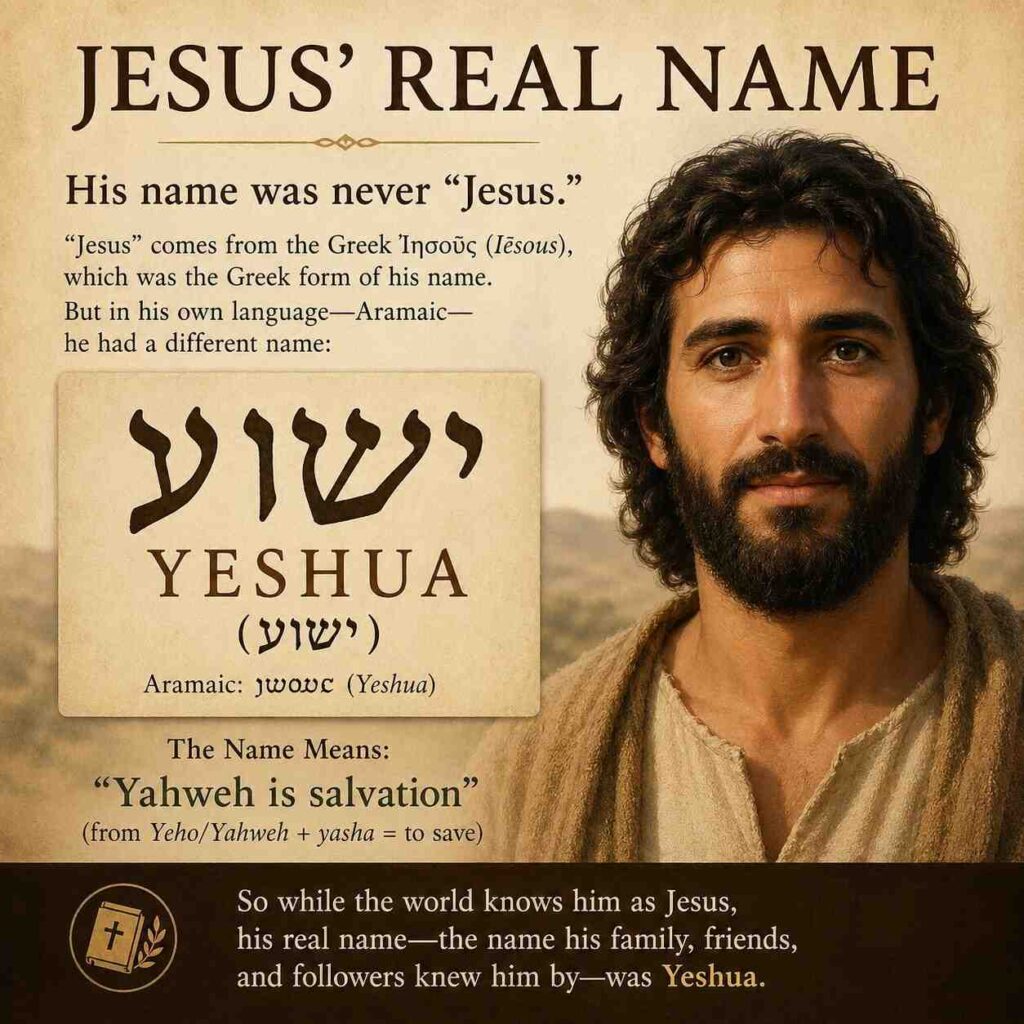
Jesus’ real name was Yeshua. Consequently, everything you think you know about His name has a deeper layer. This Hebrew name, pronounced Yeh-SHOO-ah, means “Yahweh saves” or “God is salvation.”
Why does this matter for you? Specifically, because knowing His real name deepens your prayers and connects you to His original identity. Furthermore, it bridges the gap between your English Bible and the Hebrew world Jesus actually lived in.
How do you use it today? Fortunately, you do not need to abandon “Jesus.” Instead, you simply add “Yeshua” as a way to honor His Hebrew heritage. Likewise, you can use both names interchangeably depending on your setting.
What Was Jesus‘ Real Name?
Jesus’ real name is the Hebrew word Yeshua (יֵשׁוּעַ). For example, Yeshua is a shortened form of the older Hebrew name Yehoshua, which English Bibles translate as Joshua. However, the meaning remains identical across all versions.
| Name | Language | Meaning | Where You Find It |
|---|---|---|---|
| Yeshua | Hebrew (original) | “Yahweh saves.” | Spoken by Jesus Himself |
| Iēsous | Greek | Transliteration of Yeshua | The entire New Testament |
| Iesus | Latin | Transliteration of Iēsous | Early church writings |
| Jesus | English | Transliteration of Iesus | Your Bible today |
Therefore, “Jesus” is not a made-up name. Instead, it is the English version of the Greek version of the Hebrew original. As a result, every step preserved the meaning even while the sounds changed.
Why Yeshua Is the Original Jesus’ Name
The original name of Jesus is Yeshua, not Iēsous or Jesus. Here is the simple historical chain to prove this point:
-
First, the angel Gabriel told Mary: “You will call His name Yeshua” (Matthew 1:21 in the original Hebrew context).
-
Second, the disciples called Him Yeshua every single day for three years.
-
Third, the New Testament was written in Greek, so Yeshua became Iēsous.
-
Finally, English translators turned Iēsous into Jesus.
Nevertheless, nobody changed His identity. Instead, they changed the sounds to fit their languages. Consequently, understanding the original gives you a richer faith.
For instance, when you say “Yeshua,” you hear the meaning “salvation” in the name itself. Conversely, when you say “Jesus,” you hear an English name that requires translation to understand.
The Powerful Meaning Behind the Name Yeshua
The meaning of “Yeshua” breaks down into two Hebrew components. Meanwhile, understanding these components unlocks the entire Gospel message.
-
Yahu – A shortened form of Yahweh, God’s personal covenant name
-
Shua – Saves, delivers, rescues, makes wide (free from distress)
Therefore, together they mean “Yahweh saves.”
Now read Matthew 1:21 with fresh eyes:
“She will give birth to a son, and you are to give Him the name Yeshua, because He will save His people from their sins.”
Consequently, the name is the mission. God did not pick a random name. Instead, He picked the name that announced exactly what He came to do.
How Yeshua Connects to Joshua in the Old Testament
Before Jesus, another Yeshua walked the earth. Specifically, that man’s name was Yehoshua, and he led Israel into the Promised Land. However, English Bibles translate his name as Joshua.
| Old Testament Joshua | New Testament Yeshua |
|---|---|
| Led Israel into the earthly Promised Land | Leads believers into eternal salvation |
| Defeated earthly enemies | Defeats sin and death |
| A human servant of God | God Himself in human flesh |
Thus, the parallel is not accidental. Instead, God was foreshadowing the greater Yeshua to come. For example, Joshua rested after conquest, but Yeshua offers eternal rest (Hebrews 4:8-10).
Should You Call Him Yeshua or Jesus?
This question creates confusion for many believers. Fortunately, the answer is simpler than you think. Here is the clear answer based on Scripture:
Call Him whatever draws you closer to Him. Nevertheless, understanding the original enriches your prayer life.
| If You Prefer “Jesus” | If You Prefer “Yeshua” |
|---|---|
| You stand with centuries of English-speaking Christians | You connect to His original Hebrew context |
| You pronounce a name that means the same thing | You hear the literal meaning every time (“salvation”) |
| God hears and answers your prayers | God hears and answers your prayers |
Pro Tip: Believers who switch to “Yeshua” do not become holier. However, many report that prayer feels more intimate. Therefore, try it for one week. Specifically, say “Yeshua” in your morning prayer every day. Then decide which feels more authentic to you.
Common Pitfall: Don’t Judge Others (Callout Box)
Common Pitfall: Do not judge other Christians for saying “Jesus” instead of “Yeshua.”
For example, Paul wrote in Romans 14 that disputes over names and days are secondary. Consequently, the person who says “Jesus” and the person who says “Yeshua” are both honoring the same Lord. Similarly, your freedom to use Yeshua does not give you permission to look down on others. Instead, use your knowledge to educate gently when asked.
A Prayer Using the Name Yeshua
Pray this prayer aloud. Furthermore, use the original Hebrew name intentionally throughout.
Father God,
I come to You in the name of Yeshua—the name that means “Yahweh saves.”
First, I thank You, Yeshua, for saving me. Before I could pronounce Hebrew, you knew my name. Likewise, before I prayed a single word, You prayed for me (Romans 8:34).
Second, I trust You, Yeshua, because Your name is a strong tower. Proverbs 18:10 says the righteous run into it and are safe. Therefore, today I run into Your name—Yeshua—and I am safe.
Third, I ask You, Yeshua, to act. John 14:13 says that whatever we ask in Your name, You will do. Consequently, I bring my requests now… [speak your needs aloud].
Finally, I praise You, Yeshua. My Savior. My salvation.
Amen.
3 Actionable Ways to Use Yeshua in Your Daily Faith (Checklist)
-
First, say “Yeshua” during your first prayer of the day. You do not need to replace “Jesus.” Instead, just add “Yeshua” as a spiritual practice.
-
Second, read Psalm 20:7 and substitute Yeshua. “Some trust in chariots… but we trust in the name of Yeshua our God.” Consequently, you will hear the verse differently.
-
Third, explain Yeshua to one person this week. Teaching others deepens your own understanding. Therefore, share what you learned here with a friend or small group.
FAQ: Jesus’ Real Name
Is it wrong to keep saying “Jesus”?
No, it is not wrong. Translating names across languages is normal. For example, Peter was Kefa in Hebrew and Petros in Greek. Similarly, Paul was Shaul in Hebrew and Paulos in Greek. Consequently, “Jesus” is simply the English translation of His name. God hears your heart, not your accent.
Did Jesus call Himself Yeshua?
Yes, He absolutely did. When He read Isaiah 61 in the synagogue (Luke 4), He read the Hebrew text aloud. Therefore, He would have heard His own Hebrew name, Yeshua, as He spoke. Nevertheless, He never corrected anyone who called Him something else in another language.
Will God answer my prayers if I say “Yeshua”?
Absolutely, God will answer. God answers prayers based on faith in His Son, not pronunciation. Therefore, whether you say “Jesus,” “Yeshua,” “Iēsous,” or “Iesus,” you are calling on the same Lord. For instance, Romans 10:13 promises: “Everyone who calls on the name of the Lord will be saved.”
Where does the name “Yeshua” appear in the Bible?
The name Yeshua appears frequently. Specifically, in the Hebrew Old Testament, Yeshua appears as a name for several people (including Joshua and a high priest in Zechariah). In the New Testament, the Greek Iēsous stands in for Yeshua. Consequently, Strong’s Concordance references the Hebrew root as H3442 (Yeshua) and H3091 (Yehoshua).
Should I change my Bible version to one that uses “Yeshua”?
No Bible version consistently uses Yeshua. However, some Messianic Jewish translations (like the Tree of Life Version) use Yeshua in the New Testament. Nevertheless, you do not need a new Bible. Instead, you only need to know the original name in your heart.


