

Introduction:
Love and hope don’t sit in separate chapters of Scripture — they show up braided together, again and again, from Paul’s letters to the Psalms. That’s not a coincidence. Bible verses about love and hope tend to get treated as two different lists, one for comfort and one for affection, as if they belong to different seasons of life. Scripture ties them together instead: hope grows out of love, and love is what makes hope steady rather than wishful.
A hope that isn’t rooted in something real eventually runs out. A love that never produces hope starts to feel hollow. This guide looks at both individually first — what the Bible actually means by each word then moves into how they connect, and finally into faith, hope, and love as one practice rather than three separate ideas. Every verse here comes from the King James Version.
At a glance: This article circles one simple idea — love and hope aren’t two separate things in Scripture; they’re two ends of the same rope. Eight verses make that case.
It starts by letting each stand on its own — 1 Corinthians 13:13 puts love above everything else; Psalm 33:18 ties hope to God’s mercy. Then the real work begins: showing how they actually operate together. Romans 8:28 says God works all things for good for those who love Him — hope here can’t stand without love underneath it. Romans 15:13 leans on one word: “abound.” Hope isn’t just enough to get by. It overflows, with some left to give away.
The part I liked writing most was Hebrews 6:10-11 — written to people who were tired, close to giving up, told their own past service was the ground their hope stood on. And Colossians 1:4-5 flips the usual order: hope comes first, everything else grows from it.
The real point: it all traces back to love.
What Does the Bible Say About Love and Hope?
Love, in Scripture, gets described through action more than feeling — patient, selfless, tied to God’s character. Hope works differently than the word suggests in ordinary use. When someone says “I hope it doesn’t rain,” there’s no real weight behind it. Biblical hope carries weight, because it’s grounded in who God is, not in how the weather — or anything else — currently looks.
Love Defined — The Cornerstone of 1 Corinthians 13:13
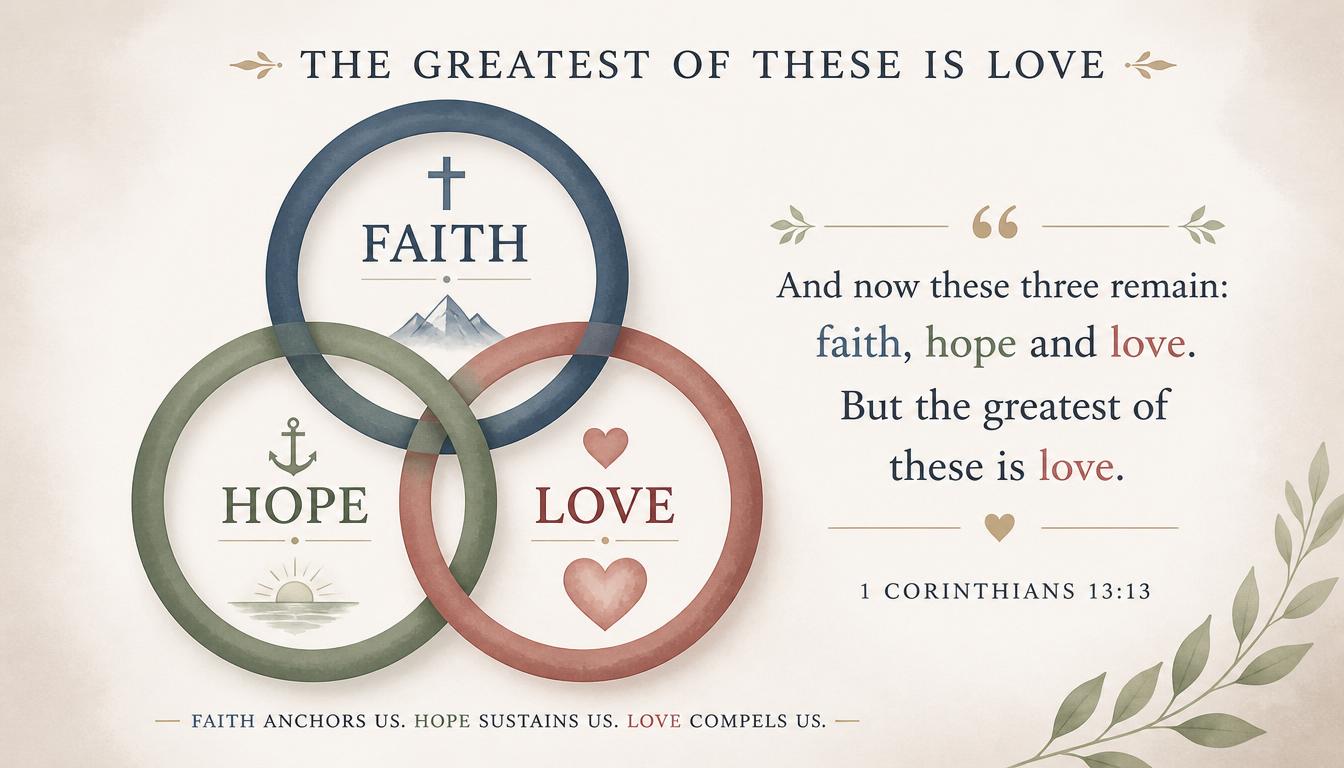
Paul’s list of what love is and isn’t, in 1 Corinthians 13, ends with a single verse that ranks it above everything else he’s just described.
“And now abideth faith, hope, charity, these three; but the greatest of these is charity.” — 1 Corinthians 13:13
Look at the order Paul chooses. Faith, hope, love — then a ranking. Love wins, and everything else in the chapter has been building toward this single line. Faith trusts God’s character. Hope expects His promises to come through. Love is the ground both of them stand on.
Hope Defined — Confident Expectation, Not Wishful Thinking
“Behold, the eye of the LORD is upon them that fear him, upon them that hope in his mercy.” — Psalm 33:18
Two things get paired here that don’t always travel together: fear of the Lord and hope in His mercy. The psalmist isn’t hedging his bets. He’s naming the actual source his confidence comes from — mercy that’s already been shown to be reliable, watched over by an eye that doesn’t wander.
How Love and Hope Work Together
Scripture presents one as producing the other, over and over, in different letters and different situations. Two examples make the pattern visible.

Hope Rooted in God Working for Good
“And we know that all things work together for good to them that love God, to them who are the called according to his purpose.” — Romans 8:28
What exactly does this verse promise? Not that every single event is good — a diagnosis, a layoff, a death aren’t good things in themselves. It promises that God works through them toward a good outcome, specifically for those who love Him. Take the love out of the verse, and the promise stops making sense. The hope depends on it.
The God of Hope Fills You With Joy
“Now the God of hope fill you with all joy and peace in believing, that ye may abound in hope, through the power of the Holy Ghost.” — Romans 15:13
“The God of hope” is a title Paul gives God only here. One word in the verse does the heavy lifting: abound. Not a trickle, not just enough to get by — something that overflows, with enough left over to hand to someone whose own hope has run dry.
Faith, Hope, and Love as One Practice
Scripture rarely treats these three as separate assignments — one for Sunday, one for hard days, one for later. They tend to show up bundled together, each expressed through the others.
“Work of Faith, Labour of Love, Patience of Hope”
“Remembering without ceasing your work of faith, and labour of love, and patience of hope in our Lord Jesus Christ, in the sight of God and our Father.” — 1 Thessalonians 1:3
Notice the verbs Paul pairs with each virtue: faith works, love labors, hope endures. Three nouns, three actions, no passive ones among them. Believers in Thessalonica are remembered for doing something with each of these, and that’s the shape this verse gives the whole idea — belief that shows up as effort.
Love That Won’t Be Forgotten, Hope That Holds to the End
“For God is not unrighteous to forget your work and labour of love, which ye have shewed toward his name, in that ye have ministered to the saints, and do minister. And we desire that every one of you do shew the same diligence to the full assurance of hope unto the end.” — Hebrews 6:10-11
This passage was written to people getting tired — the letter to the Hebrews spends a lot of time addressing believers on the edge of giving up. So the author reaches for evidence first: real service, already done, to real people. Then builds the encouragement on top of it. Keep that same diligence, he says, and let it carry you the rest of the way to hope’s full assurance.
Faith, Hope, and Love as a Way of Life
The verses above describe what faith, hope, and love are. These two turn toward what it looks like to actually live inside that connection, day to day.
Faith Working Through Love
“For we through the Spirit wait for the hope of righteousness by faith. For in Jesus Christ neither circumcision availeth any thing, nor uncircumcision; but faith which worketh by love.” — Galatians 5:5-6
Paul is settling an argument here about religious rules, but the principle reaches further than that specific dispute. Following the right procedures proves nothing on its own. What counts is faith showing up as love, in the actual doing of it — hope named right alongside, something waited for through the Spirit rather than assembled by hand.
Faith, Love, and the Hope Laid Up for You
“Since we heard of your faith in Christ Jesus, and of the love which ye have to all the saints, For the hope which is laid up for you in heaven, whereof ye heard before in the word of the truth of the gospel.” — Colossians 1:4-5
Trace the order Paul lays out. He thanks God for the Colossians’ faith and love first, then names where both of those come from: a hope already secured, waiting in heaven. Most people build the sequence the other way around — work hard, earn something, then maybe get to hope for a reward. Paul has it backward on purpose. The hope comes first here, and everything else grows out of it.
How to Use These Verses
Pick one pairing that fits where you are right now, rather than trying to hold all seven verses in mind at once. If a hard season has you doubting whether hope makes sense, start with Romans 8:28. If you’re trying to understand what love actually requires of you day to day, 1 Thessalonians 1:3 gives a shorter, more concrete picture than a whole chapter would.
Read the verse slowly once, then read it again the next morning — repetition does more here than moving quickly through the whole list.
Bible Verses About Love and Hope — Quick Reference
| Focus | Key Verse |
| Love Defined | 1 Corinthians 13:13 |
| Hope Defined | Psalm 33:18 |
| Hope Rooted in Love | Romans 8:28 |
| The God of Hope | Romans 15:13 |
| Faith, Love, Hope Together | 1 Thessalonians 1:3 |
| Love as Evidence for Hope | Hebrews 6:10-11 |
| Faith Working Through Love | Galatians 5:5-6 |
| Hope Already Secured | Colossians 1:4-5 |
Frequently Asked Questions
Q: How are faith, hope, and love connected in the Bible?
1 Corinthians 13:13 names all three as lasting qualities, with love ranked as the greatest of them — the foundation faith and hope both stand on.
Q: What is a good Bible verse about love and hope?
Romans 8:28 works well when the connection needs to feel practical rather than abstract — it ties God’s care directly to those who love Him, with hope built into the promise.
Q: Does the Bible say hope comes from love?
Not as a strict formula, but the pattern shows up repeatedly. Hebrews 6:10-11 connects hope directly to love already shown, using it as evidence for the hope that follows.
Q: What does the Bible say about being loved by God?
This page focuses on how love and hope connect to each other. For verses specifically about God’s love toward His people, Bible Verses About Love goes deeper into that ground.
Q: How many times is hope mentioned in the Bible?
The exact count varies by translation and how “hope” is counted (as a noun, a verb, or both), so no single number applies across every KJV search tool. [VERIFY EXACT COUNT BEFORE CITING A SPECIFIC NUMBER]
Related Resources
One theme steadies the other, all the way through Scripture. For the fuller collection each side belongs to, see Bible Verses About Hope and Bible Verses About Love. For the wider pillar this page sits under, see the Bible Verses hub.


