

Introduction:
People say “blessed” so often it’s almost lost its meaning — it shows up in captions, greetings, casual small talk, stripped of any real weight. Scripture uses the word differently. A biblical blessing is favor, provision, or protection that comes from God — sometimes spoken directly over a person or family, as with covenant promises going back to Genesis and Abraham, and sometimes simply given through circumstances with no formal words attached at all.
That’s a different idea from luck, from a general “good life,” or from a passing compliment. This page works through what the Bible actually means by blessing: the distinct types it describes, from provision to protection to inheritance, the key verses behind each one, and how believers are meant to both receive spiritual blessings and pass them on to others through prayer and obedience.
Along the way, it also separates blessing from closely related ideas like grace and God’s favor, since the three overlap constantly in everyday conversation and in Scripture itself. If you’ve wondered whether biblical blessing means something different from good fortune or a happy life, that’s exactly the question answered here.
Quick Overview
- A biblical blessing is favor, provision, or protection that comes from God — sometimes spoken directly over someone, sometimes given through circumstances — and it isn’t the same thing as luck or good fortune.
- Scripture describes blessing somewhat differently across the Testaments: the Old Testament often ties blessing to covenant obedience (Deuteronomy 28), while the New Testament places greater emphasis on spiritual blessing already given in Christ (Ephesians 1:3) — though traditions differ on whether this replaces or simply adds emphasis to the earlier pattern.
- The Bible names several recognizable types of blessing, including provision, protection, family and inheritance, and the specific priestly blessing found in Numbers 6:24-26.
- Believers are described as both receiving blessing and giving it — through prayer, obedience, and blessing others directly.
- Christian traditions differ on how blessing, especially prosperity, applies to life today. This page presents that range rather than treating one view as the only biblical position.
What Is a Blessing in the Bible?
A blessing in the Bible is favor or good that comes from God — provision, protection, peace, or a promise — whether spoken directly over someone or simply given throughout life. Sometimes that favor takes the form of formal spoken words: a father blessing his son, a priest blessing the people, God blessing Abraham with a covenant promise. Other times Scripture describes blessing with no spoken formula attached at all — provision in a famine, protection from an enemy, children, peace. The New Testament places greater emphasis on the blessing already given to believers “in Christ” rather than on something still being awaited, though it doesn’t rule out the idea of spoken or circumstantial blessing either.

Genesis 12:2-3 records God telling Abraham, “And I will make of thee a great nation, and I will bless thee, and make thy name great; and thou shalt be a blessing: And I will bless them that bless thee, and curse him that curseth thee: and in thee shall all families of the earth be blessed” (Genesis 12:2-3, KJV), a covenant blessing tied to a specific historical scope. Ephesians 1:3 describes believers as already blessed: “Blessed be the God and Father of our Lord Jesus Christ, who hath blessed us with all spiritual blessings in heavenly places in Christ” (Ephesians 1:3, KJV), present tense, already accomplished. Two passages, two different frames for the same word.
Blessing vs. Grace and Favor — How They Differ
Grace, favor, and blessing get used almost interchangeably in everyday Christian conversation, and Scripture itself doesn’t lay them out as a strict formula with one always producing the next. They’re overlapping concepts rather than three fixed steps. Grace generally describes God’s unmerited kindness toward people who haven’t earned it. Favor often points to a specific instance of that kindness shown toward a person or situation. Blessing frequently describes the visible or spiritual outcome — provision, protection, peace, a promise kept — though Scripture sometimes uses these words in ways that don’t fit neatly into that pattern.
A believer might describe a job opportunity as God’s favor, then call the resulting stability for their family a blessing. Same event, two different words depending on which part of it you’re naming. In everyday speech, that overlap barely matters. When reading Scripture closely, it’s worth noticing which word a passage actually uses and in what context, rather than assuming one term always leads mechanically to the next.
Old Testament vs. New Testament Views of Blessing
Blessing is described somewhat differently across the two Testaments, though Christian traditions differ on how to characterize the difference. In the Old Testament, blessing is frequently tied to covenant obedience. Deuteronomy 28 opens with an extended list of blessings promised for obedience: “Blessed shalt thou be in the city, and blessed shalt thou be in the field” (Deuteronomy 28:3, KJV), followed by consequences for disobedience later in the same chapter — a conditional structure connecting blessing to Israel’s covenant relationship with God.
The New Testament places a different emphasis. Ephesians 1:3 describes believers as already blessed with “all spiritual blessings” through their relationship with Christ, language that leans spiritual rather than material. That doesn’t settle whether material or covenant blessing disappears from view, though — Christian traditions differ, with some centering New Testament blessing on spiritual standing and others holding that material blessing carries forward too. This page won’t claim more certainty than the text supports.
Types of Blessings in the Bible
Scripture doesn’t describe blessing as one uniform thing. It shows up in several recognizable categories, each tied to specific circumstances and specific promises. One well-known passage — the priestly blessing in Numbers 6:24-26 — doesn’t fit neatly into a single category below; it’s a specific spoken formula touching on protection and peace, introduced in that section and covered in full afterward in its own dedicated section.
| Type of Blessing | Key Reference | Read More |
| Provision & Prosperity | Deuteronomy 28:1-14 | [CLUSTER CONTENT OPPORTUNITY — not yet live] |
| Protection & Peace | Psalm 23 | [CLUSTER CONTENT OPPORTUNITY — not yet live] |
| Family & Inheritance | Genesis 49; Psalm 127:3-5 | [CLUSTER CONTENT OPPORTUNITY — not yet live] |
| Spiritual Blessings | Ephesians 1:3 | [CLUSTER CONTENT OPPORTUNITY — not yet live] |
Blessings of Provision and Prosperity
Deuteronomy 28 continues past the verse quoted above into specific material terms — harvest, herds, household, “the fruit of thy body, and the fruit of thy ground, and the fruit of thy cattle” (Deuteronomy 28:4, KJV). That’s concrete, agricultural language, tied to a specific covenant between God and the nation of Israel at a specific point in history.
How that applies to a believer’s finances or career today is the same disputed question already noted above — see Old Testament vs. New Testament Views of Blessing for the fuller discussion. In short: Christian traditions land in different places on this, and neither position is presented here as the only biblical view.
Blessings of Protection and Peace
Psalm 23 opens with “The LORD is my shepherd; I shall not want” (Psalm 23:1, KJV), and the rest of the psalm builds a picture of provision and safety under God’s care — green pastures, still waters, a table prepared even in the presence of enemies. It’s a widely known passage, and it frames blessing as protection through difficulty, not just the absence of it.
Numbers 6:24-26 does something similar in a formal, spoken structure. Known as the priestly or Aaronic blessing, it reads: “The LORD bless thee, and keep thee: The LORD make his face shine upon thee, and be gracious unto thee: The LORD lift up his countenance upon thee, and give thee peace” (Numbers 6:24-26, KJV). This passage covers both protection and peace directly, and it’s specific enough as a named concept that it gets its own full treatment below.
Blessings of Family and Inheritance
Genesis 49 records Jacob blessing each of his twelve sons individually before his death, giving each one a distinct word tied to their character and future. It’s a long chapter, too long to quote here in full, but it establishes a pattern that repeats through the Old Testament: blessing passed from father to child as a formal, spoken act, not just a general wish for a good life.
Psalm 127:3-5 picks up a related thread: “Lo, children are an heritage of the LORD: and the fruit of the womb is his reward” (Psalm 127:3, KJV). Read together, these passages frame family itself, not just individual prosperity, as one of the concrete forms blessing takes in Scripture. For a deeper collection focused on friendship and relational blessing specifically, see Blessings of Friendship Scripture.
Spiritual Blessings
Ephesians 1:3, already introduced earlier on this page, describes a category distinct from the material and relational blessings covered above: “Blessed be the God and Father of our Lord Jesus Christ, who hath blessed us with all spiritual blessings in heavenly places in Christ” (Ephesians 1:3, KJV). Paul doesn’t list a specific inventory here — the rest of Ephesians 1 goes on to name things like adoption, redemption, and forgiveness as part of what that phrase covers.
This category matters enough to name on its own because it’s the one most directly tied to New Testament teaching on blessing, and because readers researching “spiritual blessings” specifically are usually looking for this exact passage rather than the Old Testament material blessings covered elsewhere on this page.
The Priestly (Aaronic) Blessing
Numbers 6:24-26 deserves its own mention because it functions differently from most other blessing passages already covered above. God gives Aaron and his sons exact words to speak over the people of Israel — three short lines invoking the LORD’s blessing, protection, grace, and peace. Where the passages above describe blessing, this one supplies the actual script for speaking it aloud, and it remains a widely used blessing in Christian and Jewish worship today.
Its structure is worth noticing: three short lines, each pairing an action from God (bless, make His face shine, lift up His countenance) with an outcome for the person (keep, grace, peace). That pattern — divine action paired with a specific human benefit — shows up again and again across the blessing passages already covered in this section.
Bible Verses About Blessings
Every category covered above connects back to specific verses readers actually search for by name. This section pulls together some of the clearest ones, organized by what they’re really about rather than just listed one after another with no context.
Blessings Tied to Faith and Obedience
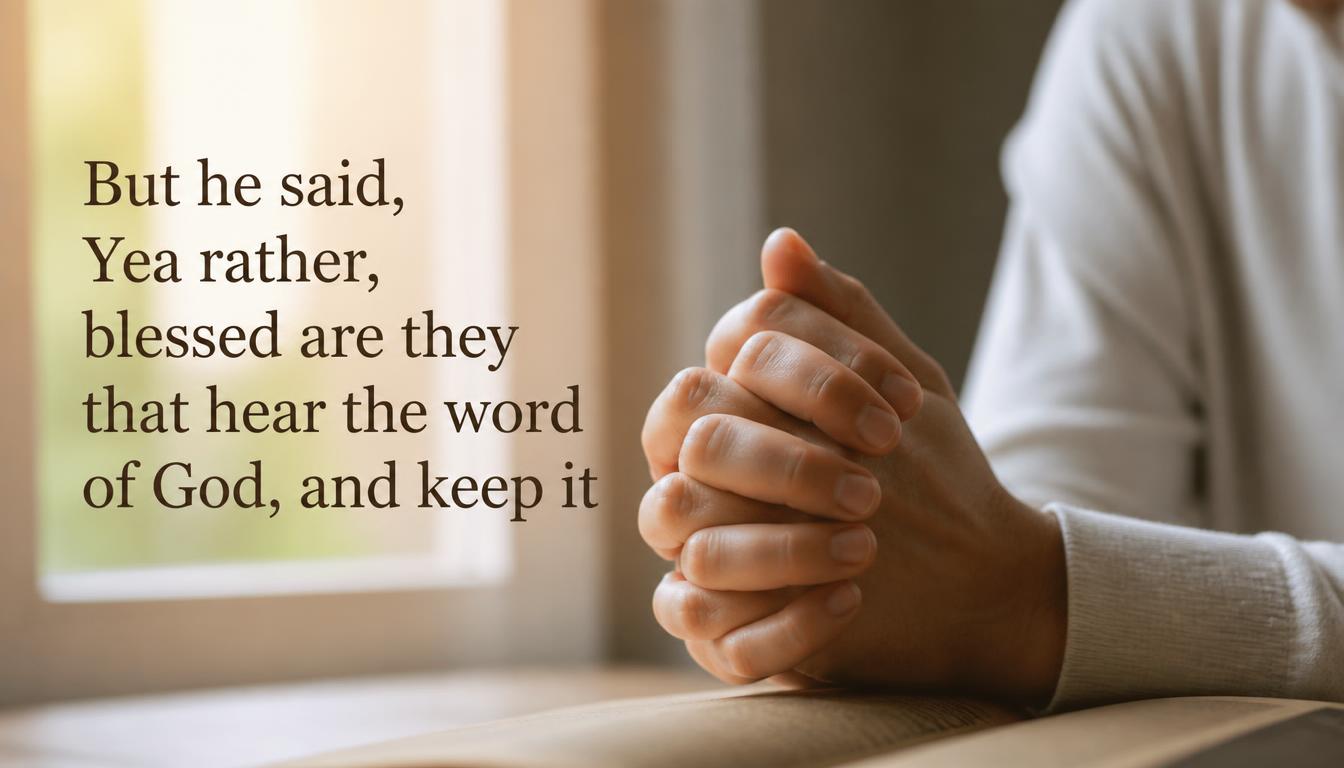
Luke 11:28 records Jesus responding to a woman who called His mother blessed for bearing Him. His answer redirects the whole idea of blessing: “But he said, Yea rather, blessed are they that hear the word of God, and keep it” (Luke 11:28, KJV). That redirect matters — Jesus moves blessing away from circumstance or birth and toward something a person actually does: hearing Scripture, then keeping it.
This lines up with the Old Testament framing already covered in Deuteronomy 28, where blessing follows obedience to God’s commands. The New Testament version of that idea shifts the emphasis away from a specific set of laws and toward a broader posture: hearing God’s word and keeping it, whatever that looks like in a given situation.
Blessings in Seasons of Hardship
James 1:12 puts blessing in a place many readers don’t expect to find it: in the middle of a trial, not after it ends. “Blessed is the man that endureth temptation: for when he is tried, he shall receive the crown of life, which the Lord hath promised to them that love him” (James 1:12, KJV). The KJV word “temptation” here translates a Greek term that covers testing or trial broadly, not only enticement toward sin — the verse is about enduring hardship and pressure, not narrowly about resisting a specific sinful urge. The trial itself stays; what changes is the promise waiting on the other side of enduring it.
That’s a useful distinction for anyone searching this topic while actually going through something difficult. Biblical blessing, in passages like this one, doesn’t mean an easy season. It means a promise attached to how someone gets through a hard one. A fuller collection of Scripture written specifically for hard seasons is available on Bible Verses About Strength in Hard Times.
Living in Light of God’s Blessings
Understanding blessing biblically is one thing. Doing something with that understanding is another. Scripture doesn’t describe blessing as something people simply wait around for — it connects to prayer, gratitude, and the deliberate act of blessing other people in return.
A Simple Blessing Prayer You Can Pray Today
Praying for blessing doesn’t require formal language or memorized words. It can be as direct as asking God for provision, protection, or peace in a specific situation, and thanking Him for what’s already been given. A short prayer might sound something like this:
“Lord, thank You for the blessings I already have, even the ones I forget to notice. I ask for Your provision where I’m lacking, Your protection where I’m afraid, and Your peace where I’m anxious. Help me trust Your timing, and help me be a blessing to someone else today. Amen.”
That’s a suggested prayer, not a Scripture quotation, and readers are free to adapt it. For a traditional example of a spoken blessing prayer passed down for generations, see the Irish Blessing — a widely known prayer of protection and peace shared across generations, though it comes from folk tradition rather than Scripture itself.
Blessing Your Family and Others
Blessing in the Bible isn’t only something to receive. Genesis 12:2-3 describes blessing flowing outward from Abraham to others: God promises to bless those who bless Abraham, and that “in thee shall all families of the earth be blessed” (Genesis 12:2-3, KJV) — meaning blessing would extend through Abraham’s line to people well beyond him, not that Abraham himself was pronouncing blessings on others. The clearer examples of a person actively speaking blessing over someone else come later: Jacob blessing each of his sons individually in Genesis 49, and the priestly blessing in Numbers 6:24-26, spoken by Aaron over the whole community of Israel.
For believers today, blessing others can look like a spoken prayer over a child, a word of encouragement to a friend, or simply thanking God out loud for someone in front of them. It doesn’t require formal training or specific wording — the priestly blessing in Numbers 6:24-26 shows that a blessing can be short, direct, and still carry real weight. For family-specific applications, Bible Verses About Mothers covers this angle in more depth.
Common Questions About Biblical Blessings
What is a blessing according to the Bible?
A biblical blessing is favor, provision, protection, or a promise given by God, or spoken over someone in His name. It appears throughout Scripture as both something God gives directly (Genesis 12:2-3) and something people speak over each other, like the priestly blessing in Numbers 6:24-26.
What’s the difference between a blessing and grace?
The two overlap, and Scripture doesn’t draw a rigid line between them. Grace generally describes God’s unmerited kindness; blessing often describes the resulting favor, provision, or promise. They’re related, overlapping ideas rather than strictly separate categories.
What is the priestly blessing in the Bible?
The priestly blessing, found in Numbers 6:24-26, is a specific spoken blessing God gave Aaron and his sons to pronounce over Israel, asking for God’s protection, favor, and peace over the people. It remains widely used in worship today.
Are blessings the same as luck or good fortune?
No. Luck implies chance with no source behind it, while biblical blessing is described as coming directly from God, tied to His character, promises, or covenant relationship with His people — not random or accidental.
How can I bless someone according to Scripture?
Scripture shows blessing others through spoken words, prayer, and encouragement — Jacob blessing his sons and the priestly blessing in Numbers 6 are examples. A modern blessing can be as simple as praying specifically for someone or speaking a sincere word of encouragement over them.
Do Old Testament blessings still apply to Christians today?
Christian traditions differ on this. Some see Old Testament covenant blessings as specific to Israel, with New Testament blessings centered on spiritual standing in Christ (Ephesians 1:3). Others hold that certain promises carry forward. Scripture itself doesn’t fully resolve every detail of this question.
A Closing Word
Blessing in the Bible runs deeper than a word people toss around casually. It’s tied to God’s character, to His promises, and to the way that favor moves through a life — sometimes as protection in a hard season, sometimes as provision nobody expected, sometimes as a simple word spoken over someone at the right moment. None of that requires perfect theology to access. It starts with paying attention to what’s already been given, and with being willing to speak a word of blessing over someone else.
If you haven’t yet, take a minute with the prayer earlier on this page, or with the priestly blessing in Numbers 6:24-26 — pray it over your own day, or over someone you know is carrying something heavy right now.
Related Resources
- Prayers for Every Moment
- Bible Study: A Complete Guide to Studying Scripture
- Bible Verses
- Blessings of Friendship Scripture
- Bible Verses About Strength in Hard Times
- Bible Verses About Mothers
- The Irish Blessing
- Christian Living


