
Introduction:
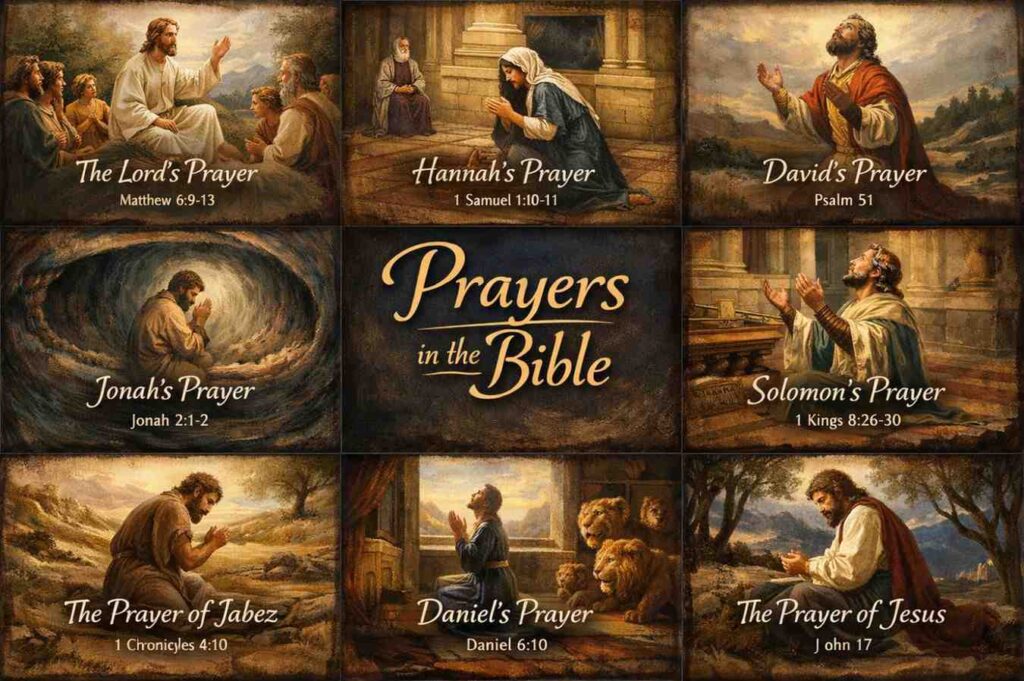
Scripture is full of people talking to God with more honesty than polish — bold requests, quiet thanks, angry questions, and humble confessions. The prayers in the Bible aren’t just a historical record; they are a working model for how to actually talk to God, whether you feel confident or unsure right now.
Whether you’re looking for the exact words Jesus Himself gave His disciples or a scripture that matches something harder to say out loud, this guide walks through the 5 major kinds of biblical prayers — praise, confession, petition, intercession, and lament — using the King James Version (KJV).
The Lord’s Prayer: Jesus’ Model for Daily Prayer
When the disciples asked Jesus how to communicate with God, He gave them a single foundational model that has shaped Christian devotion for centuries.
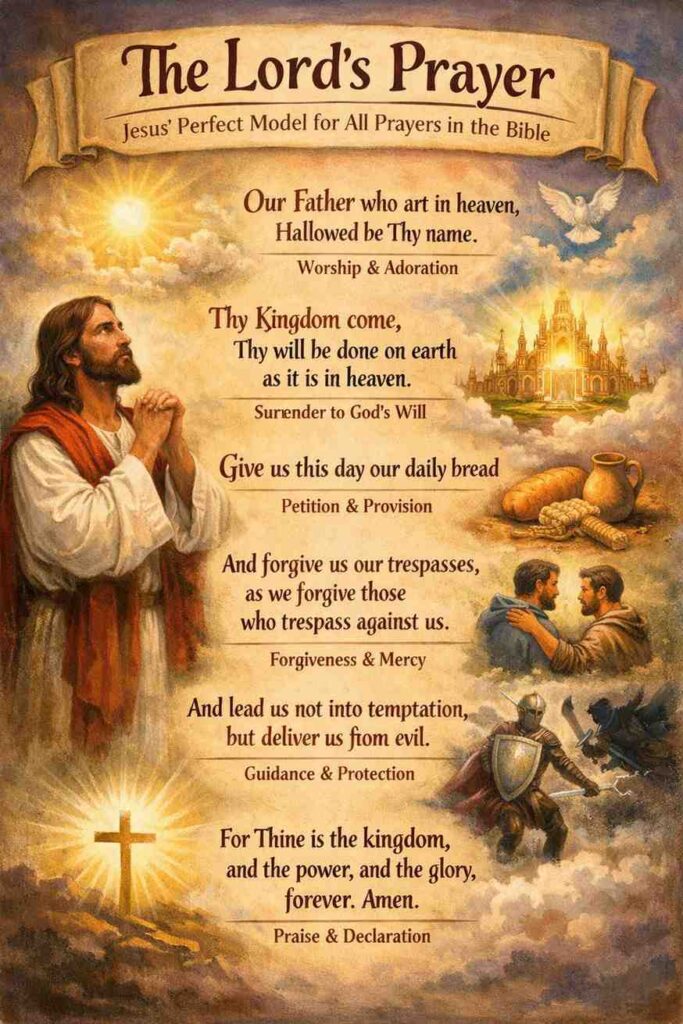
“After this manner therefore pray ye: Our Father which art in heaven, Hallowed be thy name. Thy kingdom come, Thy will be done in earth, as it is in heaven. Give us this day our daily bread. And forgive us our debts, as we forgive our debtors. And lead us not into temptation, but deliver us from evil: For thine is the kingdom, and the power, and the glory, for ever. Amen.“
— Matthew 6:9-13 (KJV)
Key Takeaway:
Jesus starts with relationship and reverence — calling God “Our Father” before making any personal requests. He establishes a clear order:
- Honoring God’s holy name
- Surrendering to His divine will
- Asking for daily provision, forgiveness, and protection
Prayers of Praise and Thanksgiving
Scripture features countless moments where believers simply magnify God’s character without attaching a personal request.
“Make a joyful noise unto the LORD, all ye lands. Serve the LORD with gladness: come before his presence with singing.”
— Psalm 100:1-2 (KJV)
King David wrote this psalm not out of perfect circumstances, but out of a deep recognition of who God is. Similarly, Mary offered a profound prayer of gratitude upon learning she would carry the Savior:
“And Mary said, My soul doth magnify the Lord, And my spirit hath rejoiced in God my Saviour.“
— Luke 1:46-47 (KJV)
Why It Matters:
Praying words of praise and thanksgiving intentionally shifts your focus away from immediate problems and fixes your attention back on God’s sovereignty.
Prayers of Confession and Repentance
The Bible doesn’t hide human flaws; it models how to approach God after personal failure.
“Have mercy upon me, O God, according to thy lovingkindness: according unto the multitude of thy tender mercies blot out my transgressions.”
— Psalm 51:1 (KJV)
David composed this prayer of repentance following his sin with Bathsheba. It stands as a masterclass in unfiltered honesty — offering no excuses, only a plea for divine mercy and a clean heart.
In the New Testament, a tax collector offers a shorter, equally powerful confession:
“And the publican, standing afar off, would not lift up so much as his eyes unto heaven, but smote upon his breast, saying, God be merciful to me a sinner.“
— Luke 18:13 (KJV)
4. Prayers of Petition and Intercession
Biblical petition means bringing specific personal needs — like healing, guidance, or protection — directly before God. Intercession means bringing those same requests on behalf of others.
Hannah’s Personal Request (Petition)
Barren and heartbroken, Hannah poured out her grief at the tabernacle until God answered her request with a son:
“For this child I prayed; and the LORD hath given me my petition which I asked of him.”
— 1 Samuel 1:27 (KJV)
Paul’s Prayer for Others (Intercession)
The Apostle Paul frequently models how to pray for the spiritual growth of other believers:
“That he would grant you… to be strengthened with might by His Spirit in the inner man; That Christ may dwell in your hearts by faith… That ye might be filled with all the fulness of God.”
— Ephesians 3:16-19 (KJV)
Prayers of Lament and Honest Struggle
Scripture makes room for raw emotional pain, grief, and confusion. A prayer of lament lets you express hardship without abandoning faith.
“How long wilt thou forget me, O LORD? for ever? How long wilt thou hide thy face from me?“
— Psalm 13:1 (KJV)
David begins this psalm in grief but resolves it by trusting in God’s unfailing mercy. Even Jesus prayed a lament from the cross:
“And about the ninth hour Jesus cried with a loud voice, saying, Eli, Eli, lama sabachthani? that is to say, My God, my God, why hast thou forsaken me?“
— Matthew 27:46 (KJV)
Prayer as Quiet Fellowship — Beyond Requests
Beyond asking or confessing, scripture describes prayer as simple presence and communion with God:
“Draw nigh to God, and he will draw nigh to you.”
— James 4:8 (KJV)
Not every prayer requires a long list of words. Some of the most meaningful moments in prayer mirror sitting quietly with a trusted friend, enjoying fellowship without feeling forced to fill every silence.
How to Apply Biblical Prayers in Your Daily Routine
You don’t need to recite every style of prayer daily. Match your selection to your current season:
- Morning Anchor: Recite The Lord’s Prayer slowly to set your spiritual direction for the day.
- In Moments of Gratitude: Read a Psalm of thanksgiving out loud.
- During Seasons of Guilt: Pray through Psalm 51 line-by-line, asking for renewal.
- When Praying for Others: Use Paul’s words in Ephesians 3 as a personalized template.
- In Grief or Heartbreak: Turn to the Psalms of lament to give honest voice to your pain.
Pro Tip: Praying scripture can feel unfamiliar at first. Consistency matters far more than eloquence — allow these ancient words to move gradually from your lips into your heart.
FAQ Section
Q1: What are the most famous prayers recorded in the KJV Bible?
The Lord’s Prayer (Matthew 6) is the most central model of Christian prayer. Other foundational examples include Psalm 23, David’s confession in Psalm 51, Mary’s Magnificat (Luke 1), and Hannah’s prayer (1 Samuel 1).
Q2: Do I need to memorize biblical prayers to pray them effectively?
No. You can read them directly from your Bible or keep a saved list of key scripture references to guide your daily quiet time.
Q3: Is it okay to use my own words alongside KJV Bible verses?
Yes. Biblical prayers serve as frameworks and starting points. You can pray the exact scripture text or use it to inspire your own personal, spontaneous words.
Q4: Where can I find prayers for physical and emotional healing in Scripture?
Specific healing promises and requests appear throughout Scripture, notably in James 5:14-15, Psalm 30:2, and Psalm 103:2-3.
Q5: Can beginners and children use Scripture to learn how to pray?
Starting with short passages like The Lord’s Prayer or Psalm 23 gives beginners and children a simple, structured foundation for building a daily prayer habit.
Q6: How can I integrate different KJV biblical prayers into my weekly routine?
Rather than trying to cover every style daily, rotate them based on your focus: use the Lord’s Prayer on weekday mornings, focus on Intercession for family on mid-week days, and reserve Psalms of Praise for weekend reflection.
Final Thoughts
The prayers in the Bible are not ancient historical artifacts to admire from afar — they are an active invitation into an authentic relationship with God. Whether you are navigating gratitude, conviction, sorrow, or uncertainty, Scripture provides a proven model. Open the Word, read slowly, and let these prayers guide your personal daily walk.


